Last updated: November 2026 · By Ben Gorski, founder of Swum
I make the Swum app (swum.ai), so read this knowing I'm biased. I swam at Notre Dame, coached, and built Swum for the team I coached. I don't sell insurance and I'm not an agent. Swum earns nothing from any company named here. Treat this as a starting point, then get real quotes and read the policy.
Where do swim instructors teach, and why does it matter for insurance?
Insurers price swim instructor coverage by where you teach. K&K's sports instructor program, for example, has one price for teaching at places you don't own, like a family's backyard pool or a rented lane, and a higher price if you also teach at your own home.
So we looked at where swim instructors on Swum actually teach:
| What we measured | Result | Sample |
|---|---|---|
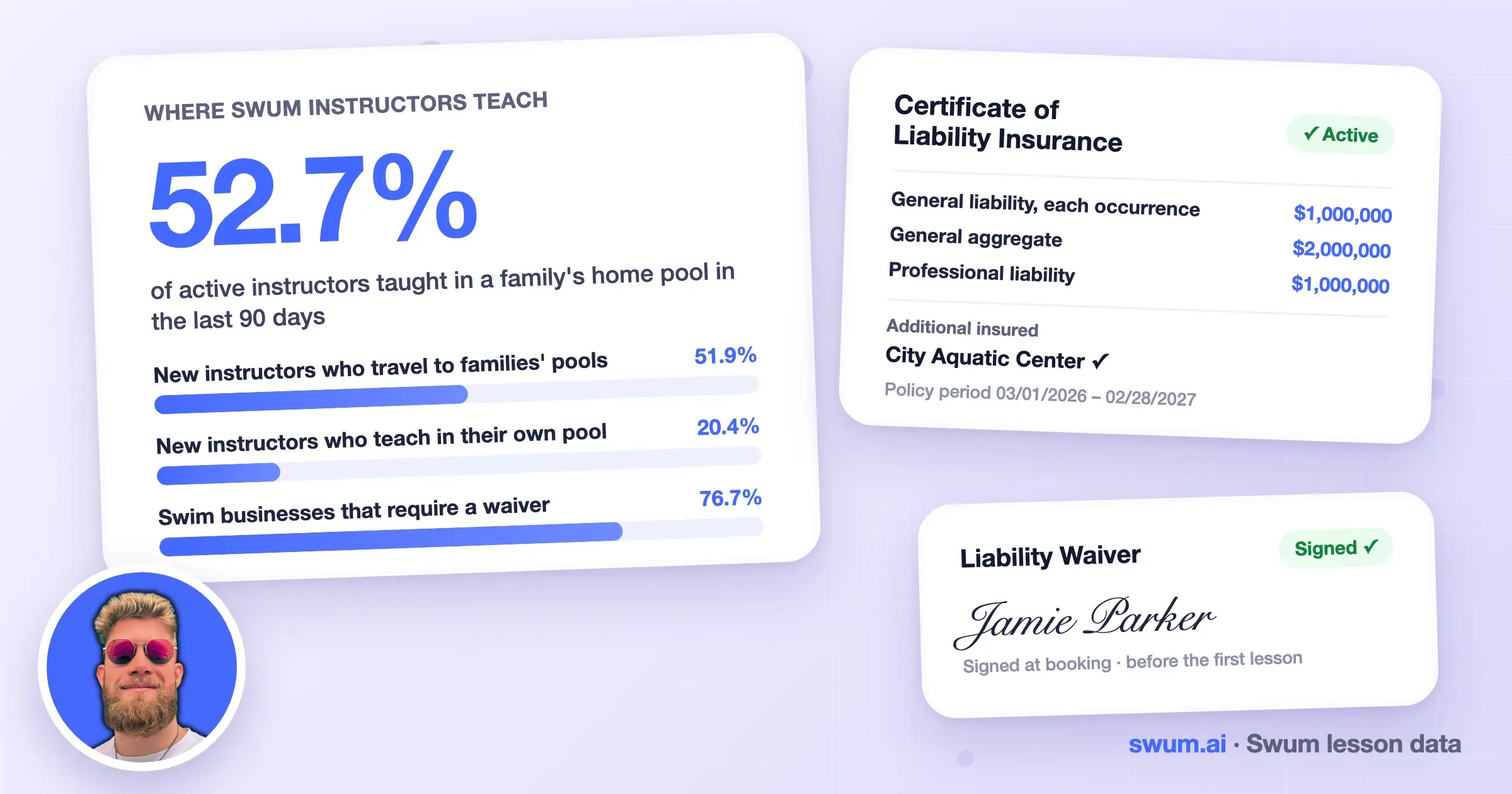
| Active instructors who taught at a family's home at least once | 52.7% | 55 instructors at 30 swim businesses, lessons in the last 90 days |
| Active instructors who taught only at families' homes | 34.5% | Same instructors |
| New instructors who say they travel to families' pools, only or as well as a pool | 51.9% | 54 instructors who joined Swum since September 17, 2026 |
| New instructors who say they teach at their own pool | 20.4% | Same instructors |
| Active swim businesses that require a client waiver | 76.7% | 30 swim businesses |
Two things follow from that:
- About half of swim instructors teach on someone else's property. Don't count on the family's homeowners policy to cover you. You need your own liability coverage that follows you to their pool.
- About 1 in 5 new instructors teach in their own pool. That's the case homeowners policies usually exclude, and the one where an instructor policy has to cover your own home too.
Swum's customers lean toward home-based and mobile instructors, so these shares likely run higher than for swim instruction overall. If you teach this way, though, you're far from alone.
What insurance does a swim instructor need?
Most independent swim instructors need two coverages, usually sold together:
- General liability. It pays for injuries and property damage to other people, like a parent who slips on the pool deck.
- Professional liability. It pays for claims about your teaching, like a family saying you moved their child to deep water too soon.
The common limits are $1 million per occurrence and $2 million aggregate (the most the policy pays in a year). Several pools' rental rules ask for exactly that (examples below).
Then add coverage for how you work:
- You teach children: ask about abuse and molestation coverage. Many general liability policies exclude it unless you add it.
- You teach in your own backyard pool: make sure the policy covers your own home. Your homeowners policy usually won't.
- You have employees: most states require workers' comp.
- Other people teach for you: your individual policy probably doesn't cover them.
How much does swim instructor insurance cost?
For one instructor, the published prices below run from about $15 a month for general liability alone to $660 a year for a $2 million package. The price depends on the limits and where you teach. These are real figures from insurers' own pages:
| Policy | Limits | Price |
|---|---|---|
| K&K Sports Instructor, Program A (you teach at pools you don't own, like client homes and rented lanes) | $1M per occurrence, $5M aggregate, $1M professional | $352 a year |
| K&K Sports Instructor, Program B (adds teaching at your own home) | Same | $440 a year |
| K&K Program A or B with $2M limits | $2M per occurrence, $5M aggregate, $2M professional | $528 or $660 a year |
| Insureon general liability, median for fitness instructors | $1M / $2M | $29 a month ($350 a year) |
| Insureon professional liability, median for fitness instructors | $1M / $1M | $42 a month ($500 a year) |
| NEXT general liability for fitness instructors | $500K to $2M per occurrence | 89% of its customers pay about $15 a month |
A few things to know about those numbers:
- K&K's prices are its published rates for policies starting March 1, 2026 through February 28, 2027. Surplus lines taxes and fees are added on top.
- Insureon's and NEXT's figures are for fitness instructors, not swim instructors. Swimming can price differently, so get a quote.
- A cheap policy that excludes where you teach is worth nothing. Check the exclusions before the price.
Where can I buy swim instructor insurance?
A few places sell coverage that names swim instructors directly:
- K&K Insurance's Sports Instructor program lists swimming as an eligible sport. It's for instructors 18 and older, and it excludes lifeguarding, diving and open-water instruction. It isn't available in Alaska or Rhode Island. It covers only you, not employees or anyone teaching on your behalf.
- Thimble sells swim instructor general and professional liability with $1 million or $2 million limits. You can buy it by the hour, day, month or year, and it says coverage applies whether you teach in a private or public space. It doesn't publish a price.
- An independent insurance agent is the better route for a swim school with staff and its own pool. You'll likely need several policies together, and an agent can shop them.
Does my USA Swimming or Masters membership cover private lessons?
Probably not. Read the rules before you rely on it:
- USA Swimming member insurance covers learn-to-swim only when a member coach teaches and every swimmer is a USA Swimming member. For other lessons, it points coaches to separate learn-to-swim coverage.
- U.S. Masters Swimming covers only sanctioned or approved activities. Adult learn-to-swim is covered inside a registered club, with no more than 3 students per instructor, all of them USMS members. Private lessons aren't mentioned.
If you teach private lessons on your own, assume you need your own policy.
What is a swim instructor insurance certificate?
A certificate of insurance (COI) is a one-page summary of your policy: the insurer, the coverages, the limits and the dates. Most use a standard form called the ACORD 25. Pools and other venues often ask for one before you teach.
A COI is a snapshot. It shows what you had on the day it was printed, so expect to send a fresh one each year.
Many pools also ask to be named an additional insured. That means your policy also defends them if a claim from your lesson names them too. It's added to your policy by an endorsement, not just typed onto the certificate.
How hard is it to get one?
- K&K issues a certificate when the policy starts. A pool's owner or manager listed as certificate holder automatically becomes an additional insured. Additional insureds from last year don't carry over, so ask again at renewal.
- Thimble emails certificates right away and adds additional insureds at no extra cost.
- NEXT says policyholders can make unlimited certificates at no extra cost, in about 10 minutes.
What do pools actually require?
Real examples from facilities' own rental documents:
| Facility | What it asks for |
|---|---|
| Juneau, Alaska city pools (commercial use) | COI with $1M per occurrence and $2M aggregate, the City and Borough named as additional insured, and an insurer rated A-VII or better by A.M. Best |
| Bristol, Connecticut aquatics center (lane rental) | Red Cross, USA Swimming, USMS or PT certification, current CPR, First Aid and AED, a COI with $1M per occurrence and $2M aggregate naming the city, and workers' comp proof |
| USA Swimming Foundation learn-to-swim provider network | Learn-to-swim insurance of $1M per occurrence and $3M aggregate, background checks and abuse-prevention training |
Ask any pool for its requirements before you sign the rental agreement, not after.
Does homeowners insurance cover swim lessons?
Usually not. The Insurance Information Institute says homeowners policies usually don't cover business liability if a customer is injured on your property. Teaching paid lessons every week is the kind of regular, for-profit activity those exclusions are written for.
That leaves two common gaps:
- Lessons in your own backyard pool. You need a policy that covers teaching at your own home, like K&K's Program B. The Insurance Information Institute also lists a home business endorsement or a business owner's policy as options. Ask your agent which fits.
- Lessons in a client's pool. The family's homeowners policy is written for the family, not for your business. If something happens, you're likely to be named in a claim too. Carry your own policy.
Do I need abuse and molestation coverage?
If you teach children, ask about it. Many general liability policies exclude sexual abuse and molestation claims. K&K's sports instructor policy, for example, excludes them unless the insurer approves the coverage and you pay for it.
Sadler, a sports insurer, says the coverage is usually added by a special endorsement, often with $1 million limits. It also says some policies void the coverage if you don't have a written background-check procedure for staff who work with kids. Programs that work with youth groups may require it.
What insurance does a swim school with staff need?
Once other people teach for you, an individual instructor policy isn't enough. Talk to an agent about:
- General and professional liability that covers the business and everyone teaching for it.
- Workers' comp for employees. The rules are set by each state. California requires it even with one employee. North Carolina generally requires it at three or more.
- Abuse and molestation coverage, plus the background checks and training that insurers and youth programs expect.
- Property coverage or a business owner's policy if you own or lease a facility.
Contractors (1099 instructors): on Swum, 88.0% of active staff at schools are set up as contractors paid by the school (142 staff at 34 schools). In most states workers' comp isn't required for contractors, but they still need liability coverage. An individual instructor policy like K&K's covers only the person who bought it. Either require each contractor to carry their own policy and send you the certificate, or make sure your school's policy covers them. How to hire and pay swim instructors covers the contractor and employee setup.
What else protects you besides insurance?
Insurance pays the bills after something goes wrong. Three habits make claims less likely and easier to defend:
-
A signed waiver before the first lesson. Collect it when the family books, not on the pool deck. In Swum, a required waiver is signed during signup or booking, before the first lesson. Waivers First asks for it before the family picks a time or pays. Signatures are saved for each swimmer, and changing the waiver's text asks everyone to sign again.
On Swum, 76.7% of active swim businesses require a client waiver, and every active school with more than one instructor does. If yours isn't required yet, turn it on before your next new family books.
-
Current certifications. Keep CPR, First Aid and your teaching certificates current, and keep copies you can send in a minute. Pools and insurers ask. See the swim instructor certification guide.
-
Written records. Write down any incident the same day: what happened, who was there and what you did. Tell your insurer about anything that could become a claim. Attendance and progress notes help too, because they show your lessons followed a plan. Swum keeps attendance and notes on each family and swimmer, but it doesn't have incident reports, so keep those in writing yourself.
For what goes in a waiver, and what it can't protect you from, read swim lesson waivers and liability. Running a school with several instructors? Here's Swum for swim schools. Teaching on your own? Start at swum.ai.
FAQ
Where do most swim instructors teach?
On Swum, 52.7% of active instructors taught at a family's home pool at least once in the last 90 days, and 34.5% taught only at families' homes. Among instructors who joined Swum since September 2026, 51.9% travel to families' pools and 20.4% teach in their own pool. Where you teach decides which insurance you need.
Do swim instructors need insurance?
Yes, if you teach paid lessons. Most swim instructors carry general liability and professional liability, usually $1 million per occurrence and $2 million aggregate. Pools that rent lanes, like the city pools in Juneau, Alaska and Bristol, Connecticut, ask for a certificate of insurance at those limits.
How much does swim instructor insurance cost?
It depends on the limits and where you teach. K&K's sports instructor program charges $352 a year at $1 million limits for teaching at pools you don't own, and $440 to include your own home. Swim schools with staff pay more.
Does homeowners insurance cover private swim lessons?
Usually not. Homeowners policies usually exclude business liability, so paid swim lessons in your own pool need a policy that covers teaching at your home. Teaching in a client's pool needs your own policy too. Don't count on the family's homeowners policy to cover your business.
How do I get a swim instructor insurance certificate?
Ask your insurer for a certificate of insurance (COI). Many issue one right away online, at no extra cost. If the pool wants to be an additional insured, give the insurer the pool's exact legal name and address so it's added to your policy, and ask again at each renewal.
Does USA Swimming insurance cover private swim lessons?
Usually not. USA Swimming member insurance covers learn-to-swim only when a member coach teaches and every swimmer is a USA Swimming member. Private lessons for non-members need separate coverage.
Do swim school contractors need their own insurance?
Usually, yes. An individual swim instructor policy covers only the person who bought it, not people teaching for them. A swim school should either require each contractor's certificate of insurance or carry a policy that covers everyone who teaches for it.