Last updated: November 2026 · By Ben Gorski, founder of Swum
I make the Swum app (swum.ai), so read this knowing I'm biased. I swam at Notre Dame, coached, and built Swum for the team I coached. The numbers below come from Swum's own booking records, anonymous and added up across swim businesses. The setup steps work whatever booking software you use.
What does Swum's data say about Google Ads for swim lessons?
Google Ads can pay for a swim school, but only if you judge them by booked families, not clicks. Swum's records answer the three questions that decide whether ads pay: what a new family is worth, how long parents take to book, and whether the booking ever gets tied back to the ad.
| What we measured | Result | Sample |
|---|---|---|
| Median spend by a new family in its first 90 days | $393.75 | 266 families, 16 swim businesses, first booking June 1 to August 19, 2026 |
| New families who paid for another booking within 90 days | 61.7% | Same families |
| Median time from first visit to the booking page to first paid booking | 10.4 hours | 500 families, 22 swim businesses |
| Families who booked more than 30 days after their first visit | 9.0% | Same families |
| Families who arrived at a Swum booking page straight from a Google ad | 0 of 1,790 | 43 swim businesses, April 11 to November 16, 2026 |
The rest of this post is what those numbers mean for your budget, your tracking and your first month of ads.
How much is a new swim family worth?
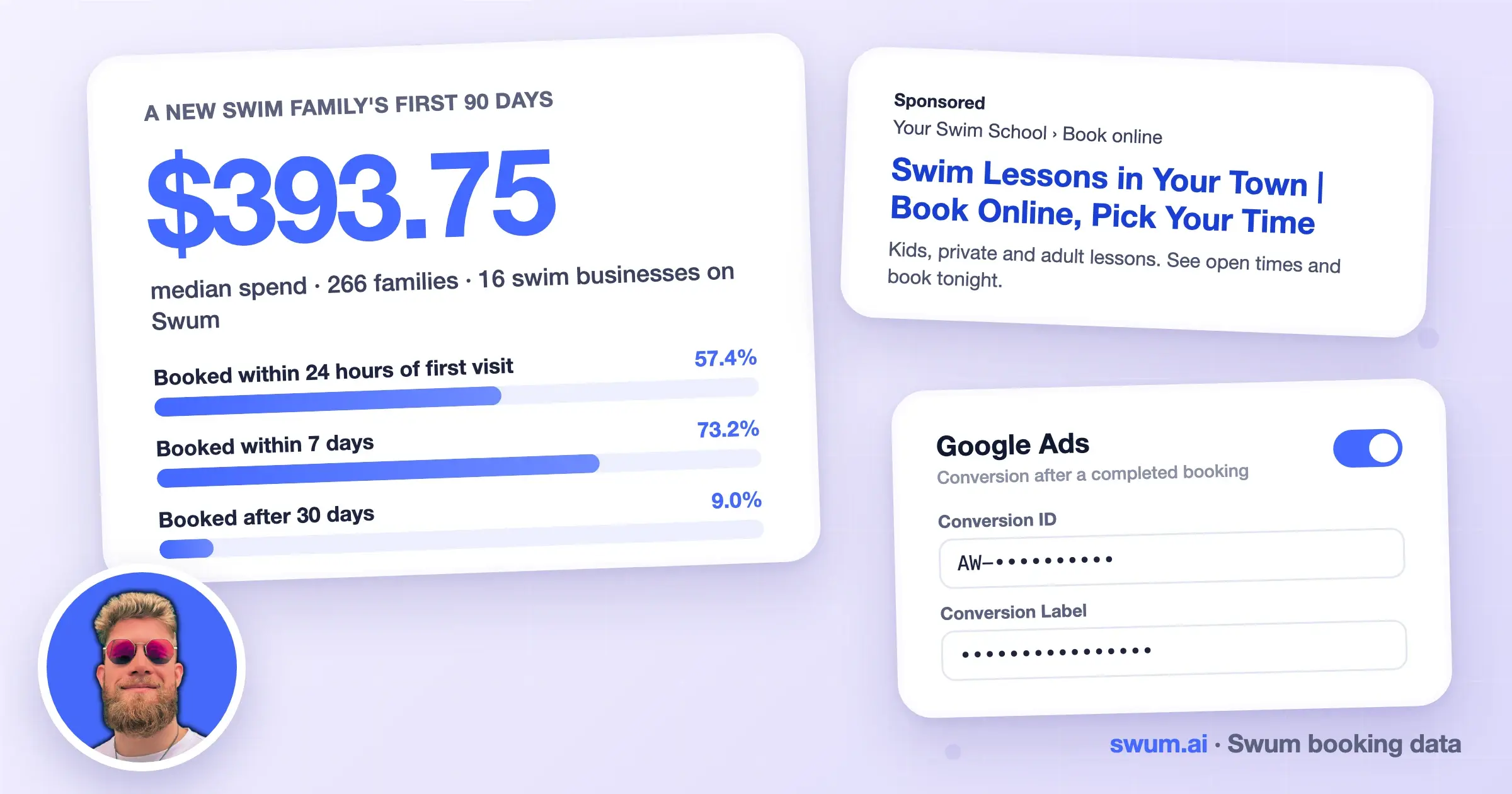
On Swum, the median new family paid $393.75 in its first 90 days. A quarter paid less than $176.62, and a quarter paid more than $765.56. The median first booking was $63, so most of that value comes after the first lesson: 61.7% of new families paid again within 90 days.
Over a longer window, families who first booked from January to May 2026 paid a median $588 in their first 180 days (326 families, 9 swim businesses).
Those are gross numbers. Before you compare them with ad costs, subtract what a lesson costs you: instructor pay, pool time and card fees. Only your books know that part.
What can I afford to pay for a booked family?
Work backward from a booked family, not a click.
A click isn't a lead, and a lead isn't a booking. On Swum, only 27.6% of families who created an account on a booking page paid for a booking within 90 days (1,516 families, 30 swim businesses). Most people who start never finish.
A worked example, not a forecast: LocaliQ's 2026 US benchmarks put the average cost per lead for Education & Instruction at $77.48. If 27.6% of those leads book, like Swum's booking-page sign-ups, each booked family costs $280.72. That's under the $393.75 median 90-day spend, but not by much once you pay the instructor. A school that turns more leads into bookings, or keeps families longer, can afford to pay more per click.
So before you raise a budget, fix the steps after the click. Make sure the ad lands where a parent can see open times and pay, and follow up with families who made an account but didn't book.
How long do parents take to book after clicking?
Making an account is quick. The median family signed up 2 minutes after first opening a swim business's booking page.
Booking takes longer. Among families who went on to pay:
- 37.4% booked within an hour of their first visit.
- 57.4% booked within 24 hours.
- 73.2% booked within 7 days.
- 9.0% booked more than 30 days later. That's a floor, since a visit is only remembered on one device.
The median was 10.4 hours. Many parents look during the day and book that night: in Swum's benchmark, 59% of completed parent bookings came outside 9 AM to 5 PM, and the busiest hour was 7 PM (when parents book).
What this means for ads:
- Don't judge an ad by today's bookings. More than a quarter of booked families (26.8%) take more than a week. Give a campaign at least a month.
- Check your conversion window. In Google Ads, every conversion action has a window for how long after a click a booking still counts. Make sure yours covers how long your families take.
- Keep ads running in the evening. Turning ads off after office hours cuts the hours when parents book most.
Why does Google Ads miss most swim lesson bookings?
Because the booking happens one step after the ad.
Of 1,790 families who created an account on a Swum booking page, none arrived straight from a Google ad. Here's where they came from:
| First visit came from | Share of families |
|---|---|
| No referrer: a typed or texted link, a QR code or an app | 53.3% |
| A link on another website, almost always the swim school's own site | 28.3% |
| Facebook or Instagram | 12.6% |
| Email apps | 1.5% |
| Other tagged links | 1.2% |
| Google search or Maps, straight to the booking page | 0.6% |
Sources with too few families or businesses to report are left out, so the shares don't add up to 100%.
That doesn't mean no family came from Google Ads. It means the ad sent them to the school's website first. Google's click ID stays on that website. When the parent taps "Book", the booking page sees a visit from the school's site, or nothing at all. Google Ads never learns that the click became a booking, so it can't optimize for bookings.
Fewer than 5 swim businesses on Swum had connected Google Ads conversion tracking to their booking page when we pulled this data.
The fix is simple: send the ad straight to the booking page for that lesson, and put the conversion tag on the booking itself. If you use Swum, that's the Google Ads setting in the next section. If you'd rather land parents on your own website, track the booking on whatever page confirms it, not the page visit.
How do I track bookings from Google Ads?
Set up a conversion in Google Ads, which is Google's word for a result you care about. For a swim school, that result is a completed booking. Mark it as a primary conversion so Google's bidding learns from it.
If your booking page is on Swum: go to Settings → Developers & Integrations → Attributed Links, turn on Google Ads, and paste in your Conversion ID (it starts with AW-) and Conversion Label from Google Ads. Swum then loads your Google tag on your public profile and school pages and reports a conversion each time a family who came through your page finishes a booking. It counts bookings, not dollars, since Swum sends the same value for every booking.
Two more checks, whatever software you use:
- Ask. Add a "How did you hear about us?" question to your booking form. In Swum, that's Settings → Client Questions on Swum Pro and up.
- Use a code. Put an intro offer in the ad, like a first-lesson discount, and count who uses it. In Swum, the First Lesson Discount is under Settings → Pricing → Advanced Options.
How should a swim school set up its first Google Ads campaign?
Campaign type: one Search campaign. Skip Local Services Ads: Google's list of eligible US categories has no swim lessons category. Skip Performance Max at first too, since it spreads a small budget across YouTube, Display and Gmail. Google calls it a complement to Search, not a replacement.
Location: a radius around the pool that matches how far families will drive every week. Under Location options, switch from the default Presence or interest to Presence, so ads only show to people who are in, or regularly in, your area. Mobile instructors: use your real service area. More than one pool: one campaign per pool.
Keywords: use phrase match ("swim lessons") and exact match ([swim lessons near me]). Google says broad match needs Smart Bidding, which needs conversion data you won't have yet. Make one ad group per lesson you sell:
| Ad group | Example keywords |
|---|---|
| Kids lessons | "kids swim lessons", "swim lessons for kids" |
| Toddler and infant | "toddler swim lessons", "infant swim lessons" |
| Private lessons | "private swim lessons", "private swim instructor" |
| Adults | "adult swim lessons", "swim lessons for adults" |
| Near me and town | [swim lessons near me], "swim lessons [your town]" |
Check each one in Keyword Planner with your location set. It shows local monthly searches and the top-of-page bid range.
Negative keywords on day one (Google doesn't match plurals for negatives, so add them yourself):
- Jobs: jobs, hiring, careers, salary, lifeguard, "swim instructor jobs"
- Certifications: certification, course, WSI, training
- Free and public: free, "public pool", "open swim", "pool hours"
- Shopping: swimsuit, goggles, "swim gear"
- Other: "swim team" (unless you run one), "how to swim", "pool cleaning"
Ads: say who it's for, where, and how to book: "Swim Lessons in [Town], Ages 3 to 12", "Book Online, Pick Your Time". Add sitelinks to each lesson's booking page, a call asset limited to office hours, and a location asset from your Google Business Profile. Google doesn't allow personalized ads aimed at anyone under 18, so write for the parent.
When should swim lesson ads run?
All day, including evenings, for the reasons above.
Two more timing facts from Swum's records:
- Parents book close to the lesson. Since August 1, the median booking on Swum was for a lesson 9.9 days away, and 43.2% were for a lesson less than a week away (4,439 bookings, 25 swim businesses). Ads can fill open spots this week, so point them at times you actually have.
- Spring is planning season. On Swum, completed bookings build sharply in spring, before lessons peak in June (the swim-lesson year). Raise budgets while parents plan, not when the pool is already full.
How much should I spend, and how should I bid?
Pick a monthly amount you're comfortable spending while you learn, and divide by 30.4 for the daily budget. Google can spend up to twice the daily budget on a busy day, but never charges more than 30.4 times the daily budget in a month.
For a sense of cost, here are LocaliQ's 2026 US search benchmarks:
| Category | Avg. cost per click | Avg. cost per lead |
|---|---|---|
| Education & Instruction | $4.81 | $77.48 |
| Sports & Recreation | $2.77 | $44.26 |
| All industries | $5.42 | $66.69 |
Your Keyword Planner bid range is the better guide for your town.
Bidding, in order:
- Maximize clicks with a maximum cost per click near the low end of your Keyword Planner range. Google suggests it for new campaigns without conversion data.
- Maximize conversions once bookings are being counted.
- Target CPA (a target cost per booked family) once you have enough data. Google says to judge it over 30 days with at least 30 conversions. Use your own family value, like the $393.75 median above, to pick a target that pays.
What's a simple first-month plan?
- Week 1: Search campaign, Presence targeting, a tight radius, 2 or 3 ad groups, the negative list, Maximize clicks with a cap. Ads point straight at booking pages, with the conversion tag on.
- Week 2: read the Search terms report. Add negatives. Pause keywords with clicks and no bookings.
- Week 3: book a lesson yourself from the ad on your phone. Can you see prices and pay in under a minute?
- Week 4: divide spend by booked families. Compare that with what a family is worth to you, and remember that more than a quarter of families take more than a week to book.
If you're still deciding where ads fit with everything else, start with 10 swim school marketing strategies. Running a school with several instructors? Here's Swum for swim schools. Teaching on your own? Start at swum.ai.
FAQ
Are Google Ads worth it for swim lessons?
They can be, if you measure booked families instead of clicks. On Swum, a new swim family spent a median $393.75 in its first 90 days, and 61.7% paid again within 90 days. Compare that with your cost per booked family, after instructor pay and pool costs.
How much is a new swim lesson family worth?
On Swum, the median new family paid $393.75 in its first 90 days (266 families across 16 swim businesses, first booking June to August 2026), and $588 in its first 180 days for families who first booked January to May 2026. That's gross spend, before instructor pay and fees.
How long do parents take to book swim lessons after clicking an ad?
On Swum, the median family booked 10.4 hours after first visiting a swim business's booking page. 57.4% booked within a day, 73.2% within a week, and 9.0% more than 30 days later, so judge swim lesson ads over at least a month.
Why doesn't Google Ads show my swim lesson bookings?
Usually because the ad goes to your website and the booking happens on a separate booking page. Of 1,790 families who created an account on a Swum booking page, none arrived straight from a Google ad, so Google never saw those bookings. Send ads straight to the booking page and put the conversion tag on the booking.
Can Swum track bookings from Google Ads?
Yes. In Swum, go to Settings → Developers & Integrations → Attributed Links, turn on Google Ads, and add your Conversion ID and Conversion Label. Swum then reports a Google Ads conversion each time a family who came through your Swum booking page completes a booking.
Can swim schools use Google Local Services Ads?
Not as a swim school. Google's list of eligible US Local Services Ads categories has no swim lessons category, so swim schools use regular Google Search campaigns instead.
How much does Google Ads cost for a swim school?
It depends on your town and keywords. LocaliQ's 2026 US benchmarks put Education & Instruction at $4.81 per click and $77.48 per lead. Google Keyword Planner shows the bid range for your own area.