You're fully booked. Your waitlist is three weeks deep, you're teaching six days a week, and you just told another family "sorry, I don't have anything until September."
That sentence is the sound of capacity leaving. Every qualified family you turn away may represent repeat lesson revenue, but the value depends on your rate, attendance and retention. Calculate it from your own records instead of assuming one industry-wide lifetime value.
The fix is hiring. But hiring is also where solo instructors get burned: misclassified workers, handshake pay deals that fall apart, and new instructors who quietly teach worse lessons under your name. This guide covers when to hire, where to find instructors, how to classify them, how to pay them, and how to keep the good ones.
One thing before we start: the classification section of this article is educational, not legal or tax advice. Worker classification rules vary by state and the penalties for getting it wrong are serious. Talk to an accountant or attorney before you bring on your first instructor.
When to Hire: The Three Signals
Don't hire because you're tired. Hire because the math says so. Look for these signals:
- A persistent waitlist. If your waitlist has held at 10+ families for a month or more - not a one-week summer spike - you have proven demand you can hand to someone else.
- You're turning away revenue weekly. Track every family you decline for a month. If you said no to 8 families, that's roughly $8,000+ in lifetime value that walked.
- Your calendar is full at your target rate. If you're booked solid and have already raised prices (see the 2026 pricing guide), the only growth lever left is more teaching hours - and you only have so many.
A useful rule of thumb: when you could fill 10-12 weekly lesson slots beyond your own capacity, you can support a part-time instructor and still make margin on their lessons.
Where to Find Swim Instructors
Good swim instructors are rarely on Indeed. They're already in and around the water. Work these pipelines:
Lifeguards at your pool. They're certified in CPR, comfortable in the water, already on deck, and usually underpaid. Watch which guards naturally engage with kids, then make an offer. You'll need to train them to teach, but the safety foundation is done.
College and high school swim teams. Competitive swimmers have stroke knowledge most adults never will. Email the coach directly and ask them to recommend two or three swimmers who are good with kids. Coaches love finding their athletes flexible, well-paying work.
Your own clients' older kids. The 16-year-old who went through your program and now swims year-round is a hidden gem: they know your teaching style because they lived it, and their parents already trust you.
Former school staff and rec instructors. Instructors at big-box swim schools and rec centers often earn $14-$18/hour while the facility bills $40+ per swimmer. A better split is an easy pitch.
Parents and teachers who swim. Elementary teachers and stay-at-home parents with a swimming background are often your most reliable hires for weekday morning and early-afternoon slots nobody else wants.
1099 Contractor vs. W2 Employee: The Honest Comparison
This is the decision that scares people, and it should be made carefully. Here's the factual landscape.
What the IRS actually looks at
The IRS uses common-law factors grouped into three categories:
- Behavioral control. Do you control how the work is done - required lesson plans, mandatory training, set teaching methods, uniforms? More control points toward employee.
- Financial control. Does the worker have their own equipment, set or negotiate their rates, work for other schools, and carry their own expenses? Independence points toward contractor.
- Relationship. Is the work ongoing and core to your business? Benefits, permanence, and work that is your business point toward employee.
Notice the tension for swim schools: the more you standardize quality (your curriculum, your methods, your training), the more the relationship looks like employment. You cannot have full creative control over someone and contractor pricing. That trade-off is real and you should make it consciously.
State rules can be stricter - especially California
Several states don't use the IRS test. California's ABC test presumes a worker is an employee unless they (A) work free of your control, (B) perform work outside the usual course of your business, and (C) have an independently established trade. Prong B is brutal for swim schools: a swim instructor teaching for a swim lesson business is squarely inside the usual course of business. Many California swim schools conclude W2 is the only defensible path. Other states (Massachusetts, New Jersey, Illinois, and more) apply versions of the same test.
Consult a local accountant or attorney before classifying anyone. Misclassification penalties include back payroll taxes, interest, fines, and in some states personal liability. This paragraph is not a formality - it's the most important one in this section.
Side-by-side
| Factor | 1099 Contractor | W2 Employee |
|---|---|---|
| Payroll taxes | They pay self-employment tax | You pay ~7.65% FICA + unemployment |
| Workers' comp | Generally not required (varies by state) | Generally required |
| Control over methods | Limited - they decide how to teach | Full - your curriculum, your rules |
| Scheduling control | They accept/decline; you can't mandate shifts | You set the schedule |
| Equipment/insurance | They bring their own, carry own liability policy | You provide both |
| Training you can require | Minimal (orientation, safety) | Unlimited |
| Admin overhead | 1099-NEC at year end | Payroll runs, withholding, W2s |
| Typical fit | Experienced instructor with own clients and insurance | Anyone you'll train and direct closely |
The honest summary: contractors are cheaper and simpler if the relationship genuinely qualifies. If you're going to train someone from scratch, hand them your lesson plans, and tell them when and how to teach - that's an employee in most analyses, and pretending otherwise is the expensive kind of optimism.
Pay Structures That Work
However you classify, you need a pay structure that's simple, motivating, and leaves you margin. Three models dominate:
| Pay model | Typical range | Best for | Watch out for |
|---|---|---|---|
| Per-lesson flat rate | $20-$45 per 30-min lesson | Predictability; new instructors | Doesn't auto-adjust when you raise prices |
| Percentage split | 50-70% to the instructor | Experienced instructors; contractor relationships | Your margin shrinks on discounted lessons |
| Hourly + bonus | $18-$30/hr + retention or fill-rate bonus | W2 staff at a facility | Pays for time, not outcomes |
A few field notes:
- Percentage splits are the industry default for contractor-style relationships. 50/50 is common for instructors you feed clients to; 60-70% to the instructor when they bring their own clients or you're competing for scarce talent.
- Pay for the no-show. If a family no-shows and you charged them (you should - require deposits), the instructor showed up and should be paid. Eating that yourself once is cheaper than the resentment.
- Put the split in writing before lesson one. Rate, no-show policy, raise schedule, and what happens to clients if you part ways. Ambiguity here ends friendships.
- Build in a raise path. "55% to start, 60% after 100 lessons taught with a 4.5+ parent rating" keeps your best people from being poached over five points.
Keeping Quality Consistent When It's Not You in the Water
Your name is on every lesson, including the ones you don't teach. Quality drift is how growing schools die quietly - parents don't complain, they just don't rebook.
Shadow before solo. New instructors watch you teach for 2-4 lessons, then co-teach, then you watch them for 2-3 lessons before they fly alone. This costs you a few unpaid hours and saves you a season of churn.
Write your progression down. What does a "Level 2" swimmer do? What's the skill checklist between levels? If it lives in your head, every instructor will invent their own version. A shared standard - reinforced with progress tracking that parents can see - keeps everyone teaching toward the same milestones and shows families measurable movement regardless of who's in the water.
Watch the rebooking rate per instructor. It's the single most honest quality metric. A great teacher's families rebook; a mediocre one's families "take a break." Your analytics should make this visible per instructor without you building a spreadsheet.
Do a 10-minute deck check monthly. Unannounced. You're not policing - you're catching small drift (too much wall time, too little feedback to parents) before it becomes the house style.
Paying People Without Spreadsheet Hell
Here's where most growing schools bleed hours: instructor #2 arrives, and suddenly you're cross-referencing a Google Calendar against a Venmo history at 11pm on the 1st of the month.
What you actually need:
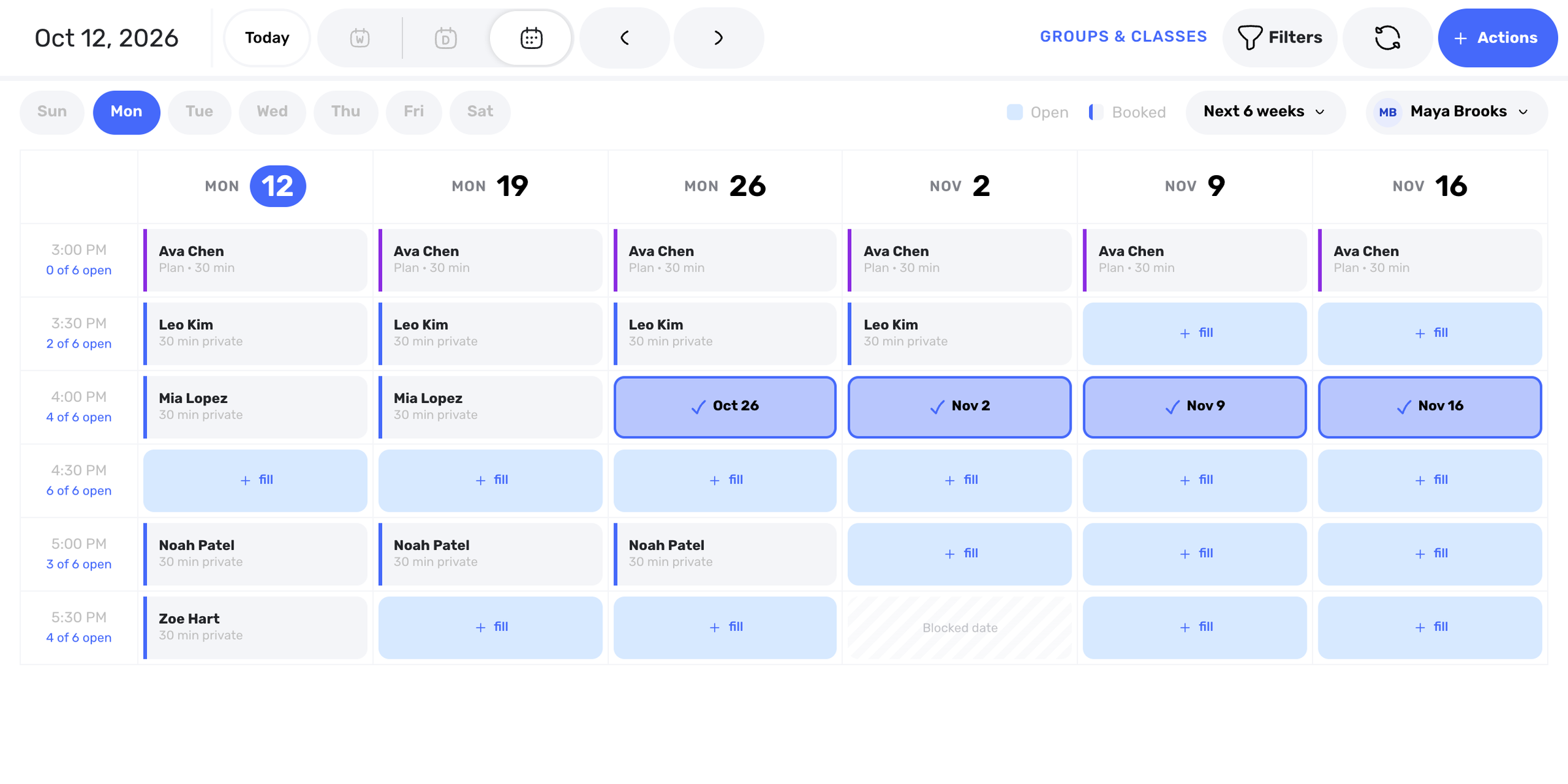
- Per-instructor schedules with self-booking. Families book directly onto a specific instructor's availability, so "who taught what" is never a reconstruction project. That's the core of multi-instructor scheduling and instructor management.
- Automatic payout math. Every completed lesson should already know its split. Swum's contractor payouts calculate each instructor's earnings from the lessons they actually taught and pay your instructors without a spreadsheet in sight.
- Admin permissions, not shared passwords. Instructors should see their own schedule and clients - not your revenue, other instructors' pay, or your whole client list. Swum's admin permissions let you scope exactly what each person can touch.
The test of a good system: when an instructor asks "what do I get paid this month?", the answer should take ten seconds and zero arguments.
Retaining Your Best Instructors
Hiring is expensive. Re-hiring is more expensive. The instructors worth keeping leave for predictable reasons - and almost none of them are purely about the rate.
- Give them full calendars. An instructor with 4 scattered lessons a week will leave for anyone offering 12 back-to-back. Concentrate their schedules; protect their drive time.
- Raise the split before they ask. A scheduled raise at 100 and 250 lessons costs you a few percent and removes the main reason to shop around.
- Hand them growth, not just hours. Let a senior instructor run your group program, train new hires (paid), or own a second location. Title and trust retain people that money alone doesn't.
- Never compete with them for clients. If a family asks for you specifically and your instructor has been teaching them well, back the instructor. Undercutting your own staff for ego bookings is the fastest way to lose them - and their clients.
- Pay on time, every time. Late or sloppy payouts are the #1 trust-killer in contractor relationships. Automate it and never think about it again.
When you're ready to run a real team - schedules, splits, permissions, payouts - that's exactly the gap between solo tools and swim school software. The 2026 software buyer scorecard includes a staff-and-payout proof section for comparing finalists.
FAQ
When should I hire my first swim instructor?
Hire when you have a persistent waitlist (10+ families for a month or more), you're turning away bookings weekly, and you're fully booked at your target rate. As a rule of thumb, you should be able to fill 10-12 weekly lesson slots beyond your own capacity before bringing someone on.
Should swim instructors be 1099 contractors or W2 employees?
It depends on how much control you exert and your state's rules. The more you dictate methods, training, and schedules, the more the relationship looks like W2 employment - and states like California apply an ABC test that classifies most swim instructors as employees. Consult an accountant or attorney before classifying anyone.
How much should I pay a swim instructor?
Percentage splits of 50-70% of the lesson price to the instructor are typical for contractor-style relationships, with flat rates of $20-$45 per 30-minute lesson and hourly rates of $18-$30 also common. Pay more when the instructor brings their own clients or experience.
What is a fair percentage split for swim instructors?
A 50/50 split is common when you supply the clients, pool, and booking system; 60-70% to the instructor is typical when they bring their own client base or rare credentials. Put the split, no-show policy, and raise schedule in writing before the first lesson.
How do I keep lesson quality consistent across instructors?
Use a shadow-then-solo onboarding (2-4 observed lessons before teaching alone), a written skill progression every instructor teaches toward, and per-instructor rebooking rates as your quality metric. Monthly unannounced deck checks catch drift early.
How do I pay multiple swim instructors without spreadsheets?
Use software where every booked lesson is already assigned to an instructor with a known split, so payouts calculate themselves. Swum handles per-instructor schedules, contractor payouts, and scoped admin permissions on its free Standard plan.
Ready to grow past a one-person calendar? Create your free Swum account and run instructor schedules, splits, and payouts in one place - or see how contractor payments work on Swum.