You teach other people's children, in water, often in pools you don't own. That sentence is your entire risk profile, and it's why waivers and insurance aren't paperwork - they're the difference between a bad day and a business-ending one.
Here's what most instructors get wrong: they treat the waiver as a magic shield (it isn't), skip insurance because "nothing's happened yet" (the worst possible reasoning), and collect signatures on a wet clipboard during lesson one (after the child is already in the water).
This guide covers what waivers actually do, what a solid one contains, the insurance layers that matter, and the collection workflow that holds up.
Read this first: this article is educational, not legal advice. Waiver enforceability varies dramatically by state - some states enforce parental waivers for minors, others largely refuse to. Insurance needs vary by how and where you teach. Have an attorney licensed in your state review your waiver, and talk to an insurance broker who knows aquatics. The few hundred dollars that costs is the cheapest risk management you will ever buy.
What a Waiver Actually Does (and Doesn't)
A liability waiver does two real things:
- Deterrence and expectation-setting. A family that signed a clear assumption-of-risk document understands swimming carries inherent risk. Many disputes end here, before anyone calls a lawyer, because expectations were set in writing.
- Documented assumption of risk. If a claim does happen, a well-drafted waiver is evidence the family knowingly accepted the inherent risks of swim instruction. In many states, that's a meaningful defense against ordinary-negligence claims.
Now the limits, which matter just as much:
- No waiver protects you from gross negligence. Leaving a non-swimmer unattended, teaching without rescue capability, ignoring an obvious medical event - no document waives that, in any state, ever.
- Waivers for minors are shaky in many states. Some states enforce a parent's waiver of their child's claims; others void them as against public policy. Your attorney will know where your state lands.
- Vague waivers fail. Courts routinely toss waivers that bury the release in fine print or never name the actual risks. Specificity is what makes them work.
The honest mental model: the waiver is your seatbelt, insurance is your airbag, and good supervision is the actual driving. You want all three.
What a Solid Swim Lesson Waiver Contains
Have a lawyer draft or review yours - but walk in knowing what it should include:
| Component | Why it matters |
|---|---|
| Named, specific risks | "Drowning, slips and falls on the pool deck, submersion injuries, illness from pool water" beats "injuries may occur." Specificity is enforceability. |
| Assumption of risk + release language | The legal core - the signer acknowledges inherent risks and releases ordinary-negligence claims to the extent state law allows. |
| Medical emergency authorization | Permission to administer first aid/CPR and to call EMS, and consent for emergency treatment if a parent is unreachable. Without this, you're improvising in the worst moment. |
| Emergency contacts + medical info | Two contacts, allergies, conditions (asthma, seizures, heart conditions), medications. You should know about the seizure disorder before the first lesson, not during it. |
| Parent/guardian signature for minors | Children can't sign contracts. The signing adult should attest they are the parent or legal guardian. |
| Photo/media consent - separated and optional | Never bury media consent inside the liability release. Make it a separate, optional checkbox so a family can decline photos without refusing the waiver. |
| Cancellation/payment policy acknowledgment | Not legally required, but bundling policy acknowledgment with the waiver kills the "I never knew about your 24-hour policy" dispute. |
One more drafting note: name yourself, your business entity, and (if relevant) the facility in the release. If you teach as an LLC, the waiver should protect the LLC and you personally as its instructor.
The Collection Workflow Is Where Instructors Actually Fail
A perfect waiver that isn't signed is worth nothing. The classic failure modes:
The paper binder. Signatures live in a binder in your trunk. Pages get wet, families get missed, and three years later - when it matters - you can't find the Hendersons' form. Paper systems fail silently.
The deck signature. A parent scribbles a signature while their kid is already on the pool steps. Two problems: the child was in your care before any risk was accepted, and a signature collected in a rush, unread, is exactly the kind a lawyer attacks later.
The "I'll send it after." You won't, or they won't. Now you've taught four lessons with no waiver at all.
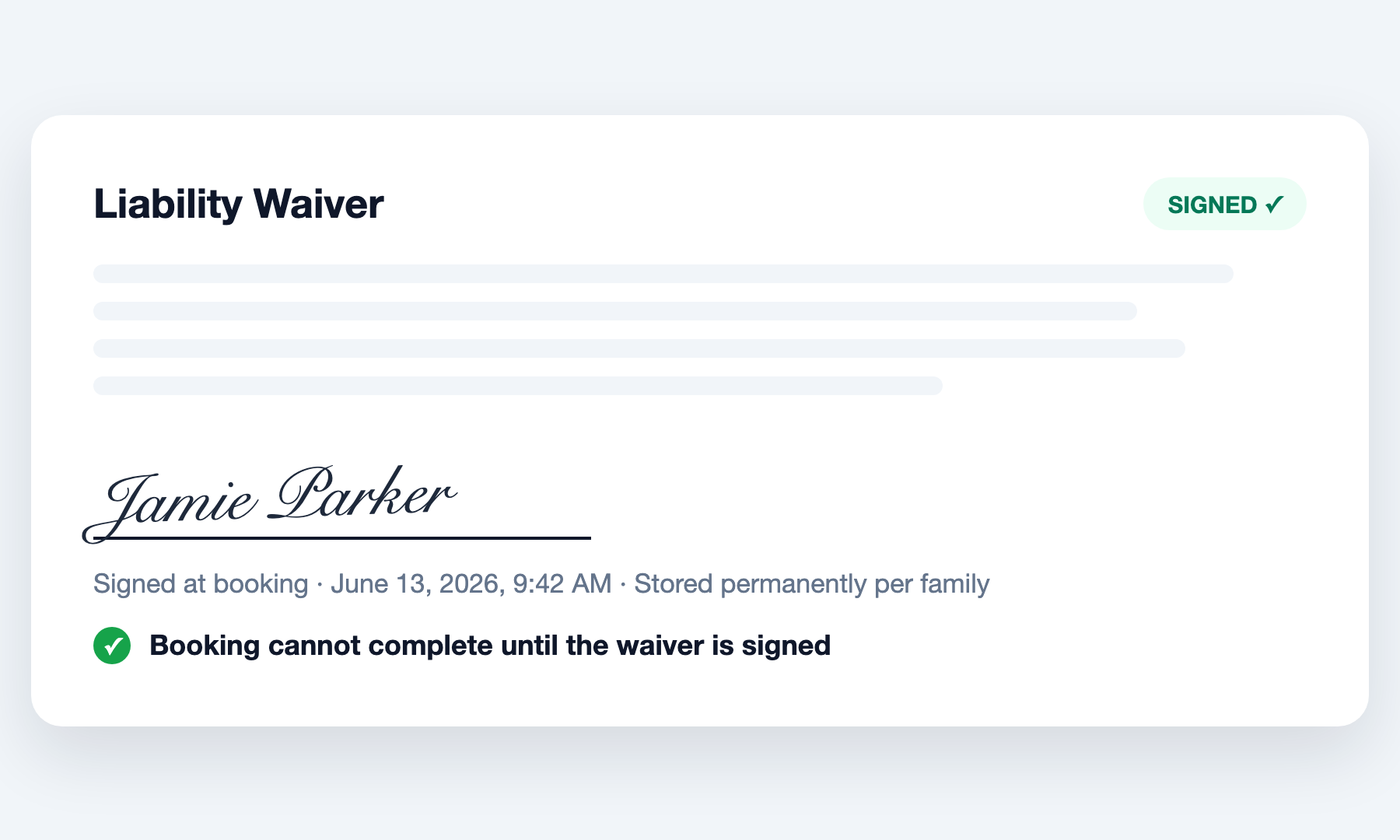
The fix is structural, not motivational: make the waiver a gate in your booking flow. No signed waiver, no confirmed booking, no exceptions - including for your friends, who are statistically your loosest paperwork.
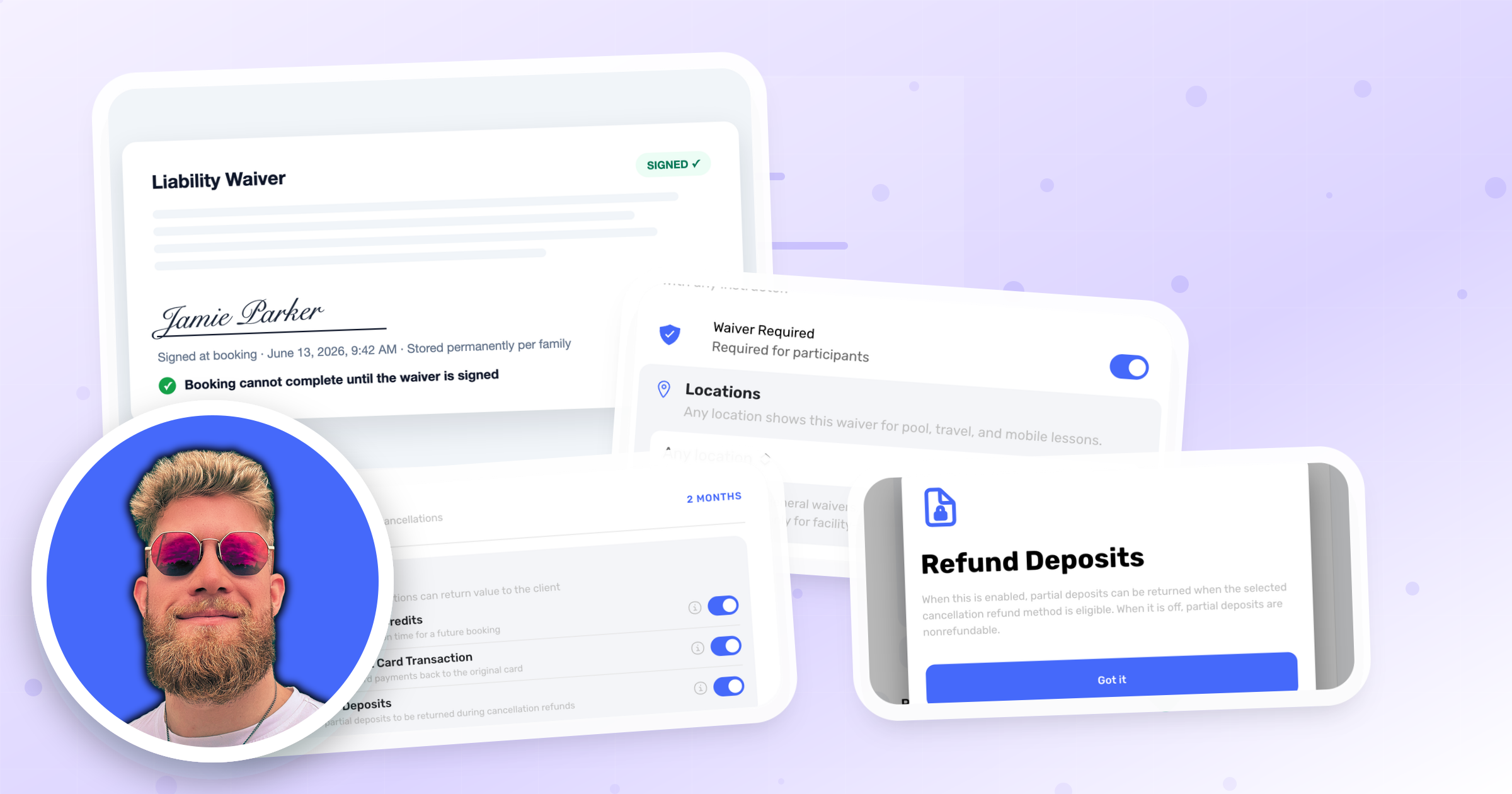
This is exactly what digital waivers exist for. In Swum, the waiver is collected at booking - before anyone touches water - signed electronically, timestamped, and stored permanently per family. When a parent books their second kid, the file is already there. If you run a team, every instructor's clients are covered by the same gate automatically, which matters more as you grow into a school.
Refresh signatures annually or whenever your attorney updates the language. A waiver signed four years ago for a different program is a weak document.
Insurance: The Layers That Matter
A waiver manages the legal argument. Insurance pays the bills. Here's the stack, with typical US market figures - get real quotes for your situation.
General liability (the foundation)
Covers third-party bodily injury and property damage - the slip on the deck, the broken gate at a client's pool. The standard structure for swim instructors is $1 million per occurrence / $2 million aggregate.
Typical cost for an independent instructor: roughly $300-$900 per year, depending on state, revenue, and whether you teach in your own pool, client pools, or rented facilities. Many instructors buy it through aquatics or fitness-industry programs that bundle it with professional liability.
Professional liability (errors in instruction)
General liability covers the wet deck; professional liability covers your teaching - a claim that your instruction, supervision, or skill assessment was negligent ("you passed my child to deep water before she was ready"). For someone whose product is instruction in a drowning-risk environment, this is not optional. Bundled GL + professional policies for instructors commonly run $400-$1,200 per year combined.
Where you teach changes everything
| Teaching location | Insurance reality |
|---|---|
| Client's home pool (mobile instructors) | Your policy must explicitly cover off-premises instruction. Don't assume the homeowner's policy covers you - many exclude business activities conducted on the property, and you may be the deepest pocket present. |
| Rented facility / lane time | Facilities almost always require proof of insurance and demand to be named as an additional insured on your policy. Most insurers issue these certificates free or cheap - ask before you sign the rental agreement, not after. |
| Your own backyard pool | Your homeowner's policy almost certainly excludes business use. Teaching paid lessons in your pool without a commercial policy is one of the largest uninsured exposures in this industry. |
Mobile instructors should treat the off-premises question as the first thing they ask any broker.
Structure helps too
An LLC separates business liabilities from your house and savings - cheap to form, and most attorneys recommend one for anyone teaching regularly. An LLC is not a substitute for insurance; it's the container the insurance sits in.
Certifications: Your Insurability and Your First Defense
Certifications do three jobs: they make you a better instructor, they lower the chance you're found negligent, and they're often required to get insured at all.
- Current CPR/First Aid is table stakes. Many insurers won't write a policy without it, and an expired CPR card is the first document a plaintiff's lawyer requests. "Current" means current - calendar the renewal.
- Lifeguard certification or equivalent rescue training strengthens both your real-world readiness and your defensibility.
- Learn-to-swim credentials (WSI or equivalent) document that your methods follow a recognized standard rather than improvisation.
Keep digital copies of every current certificate where you can produce them in 30 seconds - facilities, insurers, and new-instructor checklists all ask for them.
Incident Documentation: The Habit That Saves You
Claims often surface months after the event. Your defense is whatever you wrote down on day one.
Build this reflex for any incident - injury, near-miss, medical event, even a scary swallow-and-cough:
- Write it down within 24 hours: date, time, location, who was present, what happened, what you did, in factual language. No speculation, no admissions - just observations.
- Note witnesses and, if at a facility, file their incident report too (and keep your own copy).
- Tell the parent the same day, factually and calmly. Families sue surprises far more often than they sue honesty.
- Notify your insurer of anything that could become a claim. Late notice is a classic reason coverage gets denied.
- Keep lesson records. Attendance and progress notes quietly establish that your instruction was structured and your skill progression was deliberate - which is exactly what "reasonable care" looks like in hindsight.
A clean file of waivers, certifications, incident notes, and lesson history is what "professionally run" looks like to an insurer, a facility, and a courtroom alike.
Your 7-Point Risk Checklist
- Attorney-reviewed waiver, specific risks named, minor-signature handled for your state
- Waiver collected digitally at booking - a gate, not an afterthought
- General + professional liability, $1M/$2M, off-premises covered if you travel
- Additional-insured certificates filed with every facility you rent
- CPR current, renewal calendared, certificates stored digitally
- Incident documentation habit (24-hour written record, insurer notified)
- Annual review of all of the above before your busy season
None of this is why you got into teaching. All of it is why you'll still be teaching in ten years.
FAQ
Do I need a waiver to teach swim lessons?
Yes. A liability waiver documents that families knowingly accepted the inherent risks of swim instruction, deters disputes, and supports your defense against ordinary-negligence claims in many states. Have an attorney in your state draft or review it, since enforceability varies by state.
Are swim lesson waivers legally enforceable for children?
It depends on your state. Some states enforce a parent's waiver of their minor child's claims; others void them as against public policy. Even where enforceability is limited, the waiver still sets expectations, documents assumption of risk, and captures medical authorizations - so you should use one regardless.
What insurance does a swim instructor need?
At minimum, general liability insurance (typically $1 million per occurrence / $2 million aggregate) plus professional liability covering your instruction. Independent instructors commonly pay roughly $300-$1,200 per year for bundled coverage, depending on state, revenue, and where they teach.
Does homeowner's insurance cover swim lessons in a backyard pool?
Almost never. Homeowner's policies typically exclude business activities, so teaching paid lessons in your own pool - or relying on a client's homeowner's policy at their pool - usually leaves you uninsured. You need a commercial policy that explicitly covers your teaching locations.
What should a swim lesson waiver include?
Specifically named risks (including drowning), assumption-of-risk and release language, medical emergency authorization, emergency contacts and medical information, a parent/guardian signature for minors, and a separate optional photo/media consent. Specific, plain-language waivers hold up far better than vague boilerplate.
Can a waiver protect me from all lawsuits?
No. No waiver protects against gross negligence in any state, and waivers signed for minors are unenforceable in some states. Treat the waiver as one layer alongside insurance, current certifications, proper supervision, and incident documentation.
Stop chasing signatures on the pool deck. Create your free Swum account and collect digital waivers automatically at booking - signed, timestamped, and stored per family before anyone gets in the water.