“Canceled” sounds like an ending. In an operating system, it is a fork in the road.
The lesson might move. Money might return. A credit might preserve value for later. The family might book again next week—or quietly disappear.
We examined 4,293 eligible cancellation records across 70 Swum provider accounts and looked for explicit operational markers. Eleven percent were marked rescheduled. A recorded refund marker appeared on 8.5%. Another 7.8% carried a credit-to-next-plan marker, while 14.3% explicitly carried a never-award-time-credits setting.
These categories overlap and do not describe every possible remedy. That is exactly the point: cancellation is not one outcome.
The visible recovery paths
| Recorded signal | Share of cancellation records |
|---|---|
| Marked rescheduled | 11.0% |
| Recorded refund | 8.5% |
| Credit to next plan | 7.8% |
| Never award time credits | 14.3% |
A refund marker does not prove full economic loss. A reschedule marker does not prove the replacement lesson was completed. “Never award” does not rule out another remedy. These are workflow signals, not mutually exclusive final verdicts.
The relationship often continues
We also looked for a subsequent successful order by the same family with the same provider after each cancellation record.
- 16.4% had one within seven days.
- 23.2% had one within 14 days.
- 36.0% had one within 30 days.
That later order is not necessarily a direct replacement. A family may have booked a sibling, purchased a package or simply continued its normal cadence. Still, the finding corrects a common emotional error: a cancellation is not automatically customer loss.
Treat cancellation as a recovery workflow
The moment a cancellation occurs, four systems should move.
Inventory
Can the slot return to availability safely? If so, surface it immediately to qualified waitlisted families.
Value
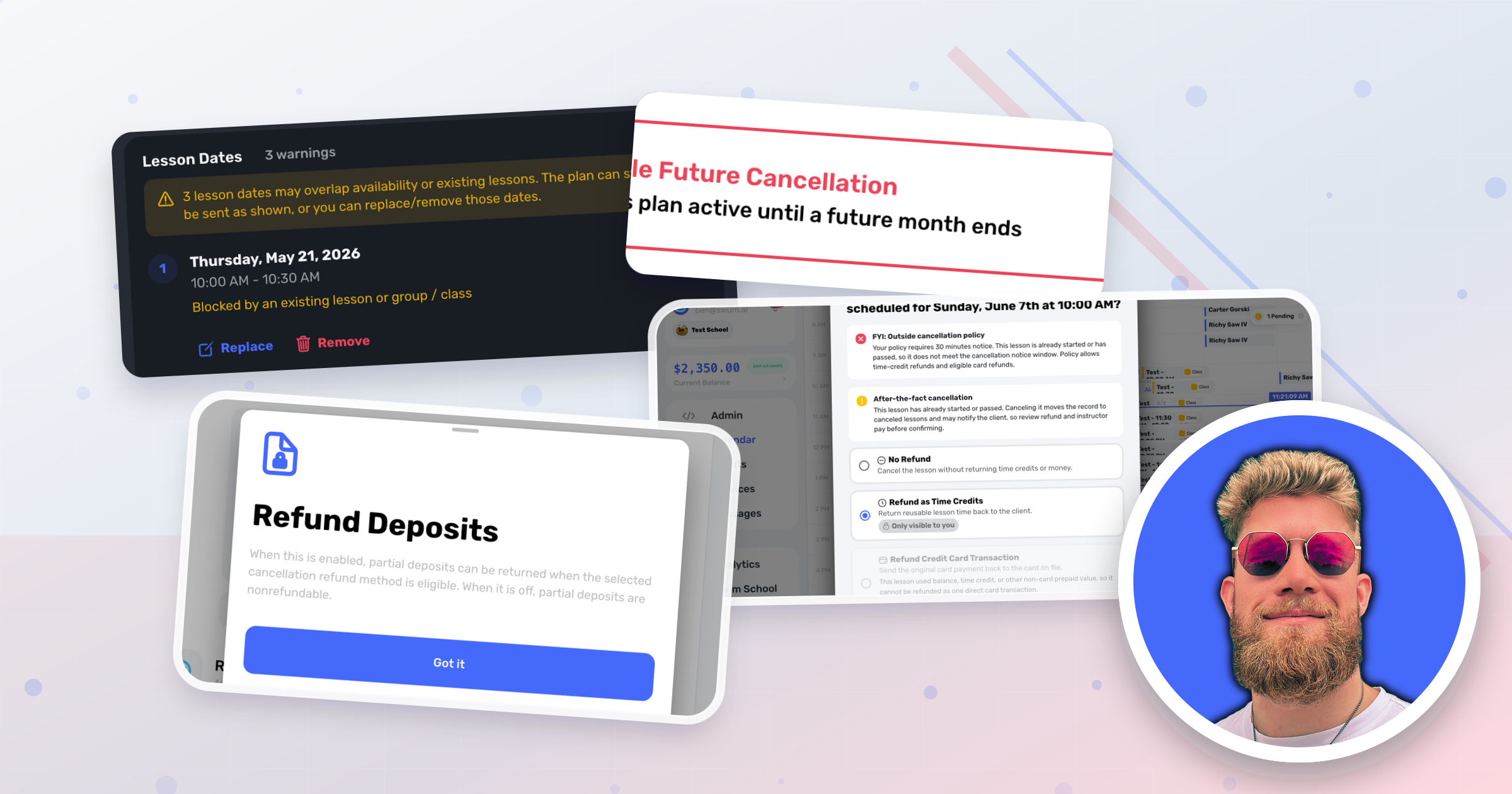
Apply the published rule: refund, time credit, plan credit, reschedule or no remedy. Record the decision in a structured field.
Communication
Tell both sides what happened, what value remains and what action is available. Ambiguity creates more churn than many policies do.
Relationship
If the family has no future lesson, create an appropriate path back. That might be a reschedule link today or a quiet reminder after the disruption has passed.
The metric that matters next
Most cancellation reports count events. Better reports measure recovery:
- percentage rescheduled;
- percentage refilled before start;
- percentage receiving each remedy;
- next completed lesson within 7/14/30 days;
- next completed order within 7/14/30 days;
- eventual inactivity after the cancellation.
Those stages separate three very different problems: lost inventory, lost revenue and lost relationships.
A humane system can also be rigorous
Operators sometimes frame cancellation policy as a choice between compassion and discipline. Structured data makes that choice less dramatic.
You can grant exceptions while recording them. You can protect late slots while offering earlier cancellations an easy reschedule. You can see whether generous remedies preserve relationships or merely postpone churn.
The cancellation record is not the story. It is the moment the story branches.
FAQ
What percentage of Swum cancellation records were marked rescheduled?
Eleven percent of 4,293 eligible records were explicitly marked rescheduled.
Do families book again after canceling?
Thirty-six percent of cancellation records had a subsequent successful order from the same family with the same provider within 30 days. That order was not necessarily a direct replacement.
Can the outcome percentages be added together?
No. The explicit markers can overlap, and some remedies are represented in workflows not captured by a single marker.
Download the aggregate editorial dataset and read the cancellation policy playbook.