The short answer: most kids can start some form of swim lessons around age 1, and most are ready for formal learn-to-swim lessons between ages 3 and 4.
The longer answer matters more, because "swim lessons" means very different things at 18 months versus 6 years - and because the reason to start has less to do with sport than with safety.
Drowning is one of the leading causes of death for children ages 1 to 4 in the United States. That's why the American Academy of Pediatrics (AAP) recommends that swim lessons can begin around age 1 for many children, as one layer of protection against drowning.
One thing to hold onto throughout this guide: no lesson, at any age, makes a child drown-proof. Lessons reduce risk. They never replace adult supervision, pool fences, and life jackets. The best swim programs will tell you this themselves - and it's actually a good sign when they do.
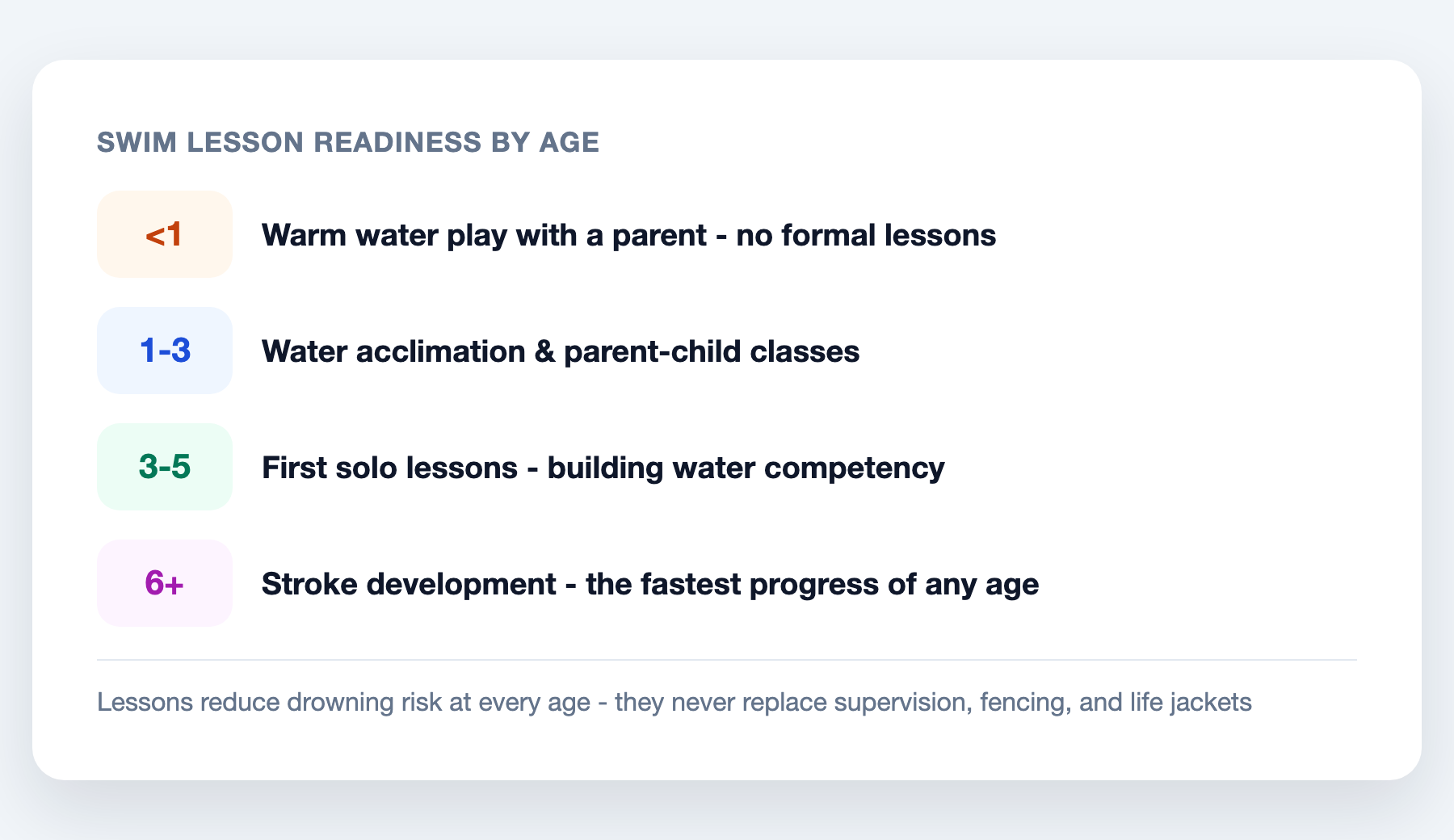
Swim Lesson Readiness by Age
| Age | What lessons look like | What kids actually learn | What to expect |
|---|---|---|---|
| 6 mo - 1 yr | No formal lessons; parent-child water play | Comfort, splashing, positive associations | Fun, not skills - there's no evidence lessons at this age reduce drowning risk |
| 1 - 3 yrs | Water acclimation; parent-child classes | Comfort going under, kicking, reaching for the wall, water habits | Progress is comfort-based, not stroke-based |
| 3 - 5 yrs | First solo (instructor-led) lessons | Breath control, floating, gliding, paddling to safety | The biggest readiness range - some 3-year-olds thrive, some 4-year-olds need another season |
| 6+ yrs | Stroke development | Freestyle, backstroke, endurance, deep-water skills | The fastest progress of any age group |
Let's break each stage down.
6 months to 1 year: water play, not lessons
Before age 1, there's no developmental basis for formal swim instruction, and no evidence that infant programs lower drowning risk. What is valuable: warm, relaxed time in the water with you. Hold your baby, bounce, sing, get their face gently wet.
You're not teaching swimming. You're preventing the water from ever becoming scary in the first place - which pays off enormously at age 3.
Ages 1 to 3: acclimation and parent-child classes
This is where the AAP says lessons can start for many children, based on the child's exposure to water, emotional maturity, and physical ability. The right format here is a parent-child class: you're in the water, an instructor guides games and skills, and your toddler learns to blow bubbles, go under briefly, kick on their front and back, and turn back to grab the wall.
That last one - turning around and reaching for the wall - is one of the most genuinely protective skills a toddler can build, since most toddler drownings involve a child falling in close to the edge.
Don't expect swimming. Expect a kid who's calm with water on their face, which is the foundation everything else is built on. If your toddler struggles with face-wetting and breath holding, these toddler breath control techniques are exactly what good instructors use at this stage.
Ages 3 to 5: first real lessons
Somewhere between 3 and 4, most kids become ready for solo lessons - in the water with an instructor, without you. Readiness looks like:
- Can separate from you for 30 minutes without distress
- Can follow simple two-step instructions
- Is comfortable getting their face wet (or at least tolerates it)
- Has the attention span for a structured half hour
Notice what's not on that list: a specific birthday. Readiness is developmental, not chronological. A confident 3-year-old can be more ready than an anxious 4½-year-old, and starting before a child is ready often costs more time than it saves - a scared kid learns nothing except that pools are scary.
If your child is fearful, that's normal and workable. Fear of water is a wiring issue, not a willpower issue - here's the science of water anxiety and how good instructors dissolve it. The right instructor at this stage is patient, playful, and never forces a crying child under.
By the end of this stage, a well-taught kid can typically float, glide, paddle several yards, and get to the wall or steps if they fall in - the skill set often called "water competency."
Ages 6 and up: stroke development - and it's never too late
If your child is 6, 8, or 10 and hasn't had lessons, you haven't missed a window. Older beginners progress faster than preschoolers: better motor control, longer attention spans, and the ability to understand instructions like "reach past your ear."
This is the age for real stroke work - freestyle with side breathing, backstroke, treading water, deep-water comfort - and the age where group classes start delivering excellent value, because kids can learn from watching peers.
What to Look For in an Instructor or Program
The instructor matters more than the brand on the building. When you evaluate a program, look for:
Current certifications. CPR certification is non-negotiable. Lifeguard training, WSI (Water Safety Instructor), or equivalent learn-to-swim certifications are strong signals.
Small ratios. For ages 3-5, look for 4:1 or better in group settings. Eight preschoolers per instructor means your kid gets three minutes of actual instruction per class.
A written progression. Ask: "What skills does my child need to move from one level to the next?" A good program answers instantly with specifics. If they can't articulate levels, they can't measure progress - yours or theirs. The best instructors share progress updates after lessons so you can actually see movement; platforms like Swum let instructors send parent-visible progress tracking so you're not guessing whether week six looks different from week one.
How they handle fear. Ask directly: "What do you do when a child cries or refuses?" The right answer involves patience, play, and gradual exposure. The wrong answer involves "they get over it" or forced submersion. Walk away from any program that dunks crying children.
Safety honesty. A program that tells you lessons don't drown-proof your child is a program that takes safety seriously.
Private vs. Group Lessons: Which Is Right for Your Kid?
| Private lessons | Group lessons | |
|---|---|---|
| Best for | Fearful kids, fast-track goals, special needs, catching up | Social learners, ages 6+, budget-conscious families |
| Typical cost | $35-$70 per 30 min (more in major metros) | $15-$45 per child per class |
| Pace | Fastest - 100% instructor attention | Slower, but kids learn from watching peers |
| Downside | Cost; no peer modeling | Less individual correction; ratios matter a lot |
A practical pattern many families use: private lessons to break through fear or a plateau, then group lessons for endurance and stroke refinement. Semi-private lessons (2-3 kids, often siblings or friends) split the difference on both price and attention.
How Long Does It Take a Kid to Learn to Swim?
Honest expectations, because no one else will give them to you:
- Water-safe is not the same as swimming. Basic water competency - float, turn, paddle to the wall - typically takes a young child several months of consistent weekly lessons, not a two-week crash course.
- A true independent swimmer (25 yards of recognizable freestyle, comfortable in deep water) is usually 1-2 years of consistent lessons for a child who starts as a preschooler. Older starters move faster.
- Consistency beats intensity. A weekly lesson year-round outperforms a summer-only blitz, because skills consolidate with repetition.
- Regression after breaks is normal. A child who floats beautifully in August may cling to you in January after four months off. It comes back fast - usually within a few lessons - but it's the strongest argument for not stopping every fall.
- Plateaus are part of it. Kids leap, stall, leap. A stalled month is not a bad instructor or a hopeless kid.
The families who succeed treat swim lessons like reading practice: a standing weekly habit, not a box to check.
The Safety Layers That Matter at Every Age
Lessons are one layer. The AAP's drowning-prevention guidance stacks several, and they all stay in place no matter how well your child swims:
- Touch supervision for non-swimmers - an adult within arm's reach, eyes on the water, phone away.
- Four-sided pool fencing with self-latching gates for home pools.
- Life jackets (US Coast Guard-approved) on boats and in open water - for every child, every time.
- Swim lessons - the layer this article is about.
- CPR-trained adults in the household.
A "water watcher" habit is worth adopting at any group swim: one named adult whose only job, in rotating shifts, is watching the water. Most child drownings happen with adults nearby but not watching.
FAQ
What age should a child start swim lessons?
Many children can start water acclimation or parent-child swim classes around age 1, and most are developmentally ready for formal solo lessons between ages 3 and 4. The American Academy of Pediatrics supports lessons from age 1 based on the individual child's readiness.
Are baby swim classes worth it before age 1?
Formal lessons before age 1 aren't recommended and haven't been shown to reduce drowning risk, but relaxed parent-child water play is valuable. It builds comfort and positive associations that make real lessons easier later.
Do swim lessons prevent drowning?
Swim lessons reduce drowning risk - research suggests meaningful risk reduction even for kids ages 1-4 - but no child is ever drown-proof. Supervision, pool fencing, and life jackets remain essential at every skill level.
How do I know if my 3-year-old is ready for swim lessons?
Look for four signs: they can separate from you for 30 minutes, follow two-step instructions, tolerate water on their face, and focus on a structured activity. Readiness is developmental, not tied to a birthday - some kids are ready at 3, others closer to 4 or 5.
How long does it take a child to learn to swim?
Basic water competency (floating, turning, paddling to the wall) typically takes several months of consistent weekly lessons, and confident independent swimming usually takes 1-2 years for young starters. Expect plateaus, and expect some regression after long breaks - both are normal.
Are private or group swim lessons better for kids?
Private lessons progress fastest and suit fearful or younger kids; group lessons cost less and work well for social learners ages 6 and up. Many families start private to build core skills, then move to group for stroke work and endurance.
Ready to get started? Find a vetted swim instructor near you and book a first lesson that matches your child's age and readiness - many instructors offer discounted first lessons so you can find the right fit.