"Sorry, we're full right now - check back in the fall!"
If that sentence, or anything like it, is your standard reply to inquiries when the schedule is packed, you are taking the most expensive lead in your business - a family that found you, trusted you, and tried to hand you money - and sending them to your competitor.
A full schedule isn't the finish line. It's the moment your waitlist becomes your most valuable asset - a pipeline of pre-sold demand that fills cancellations same-day, seeds new classes, funds expansion decisions, and smooths out churn. Most swim businesses squander it in a notes app, if they capture it at all.
Here's how to build a waitlist that actually converts.
"We're Full" With No Capture Is Burning Money
Run the math on what a turned-away family costs. The average learn-to-swim customer is worth at least $1,000 in business - and the family inquiring when you're full is the best lead you'll ever get: they came to you, they're ready to buy, and your only problem is inventory timing.
Now stack up how often that inventory problem resolves itself:
- A family cancels their package and doesn't renew (churn happens every month, even at great schools).
- A standing Tuesday slot opens when a family moves.
- You add a pool hour, an instructor, or a Saturday morning block.
Without a waitlist, every one of those openings starts a marketing project: post, promote, wait, hope. With a waitlist, every opening starts a fulfillment task: message three families, fill the slot by Thursday. Schools with worked waitlists refill churned slots in days; schools without them carry open slots for weeks - and an open slot is revenue that expires every single week it sits there.
There's a softer cost too. "We're full, sorry" ends the relationship. "We're full - want me to add you to the waitlist? Families usually get in within 4-6 weeks" starts one, and signals exactly the kind of demand that makes parents want in more.
What a Real Waitlist Records
"Name and phone number in my notes app" is not a waitlist; it's a guilt list. When a Tuesday 4pm opens for a 5-year-old beginner, a real waitlist tells you in ten seconds which families are a fit. That means capturing, at minimum:
| Field | Why it matters |
|---|---|
| Child's name, age, and skill level | A teen stroke-refinement opening is useless to a 3-year-old beginner - fit comes first |
| Schedule availability | "Weekday afternoons only" vs. "anytime" determines who can actually take the slot |
| Lesson format wanted | Private, semi-private, or group - these are different inventories |
| Date added | Your fairness baseline for ordering and your demand-trend data |
| Contact info + preferred channel | A text answered in 10 minutes beats an email answered in 3 days |
| Sibling info | Two-kid families fill two slots and anchor harder - worth knowing upfront |
| Notes | "Referred by the Garcias," "tried lessons before, fearful" - context that wins the conversion call |
Capture it the same way every time - a short form on your website or a fixed script for phone inquiries. Thirty seconds of structure at intake saves you an archaeology dig every time a slot opens.
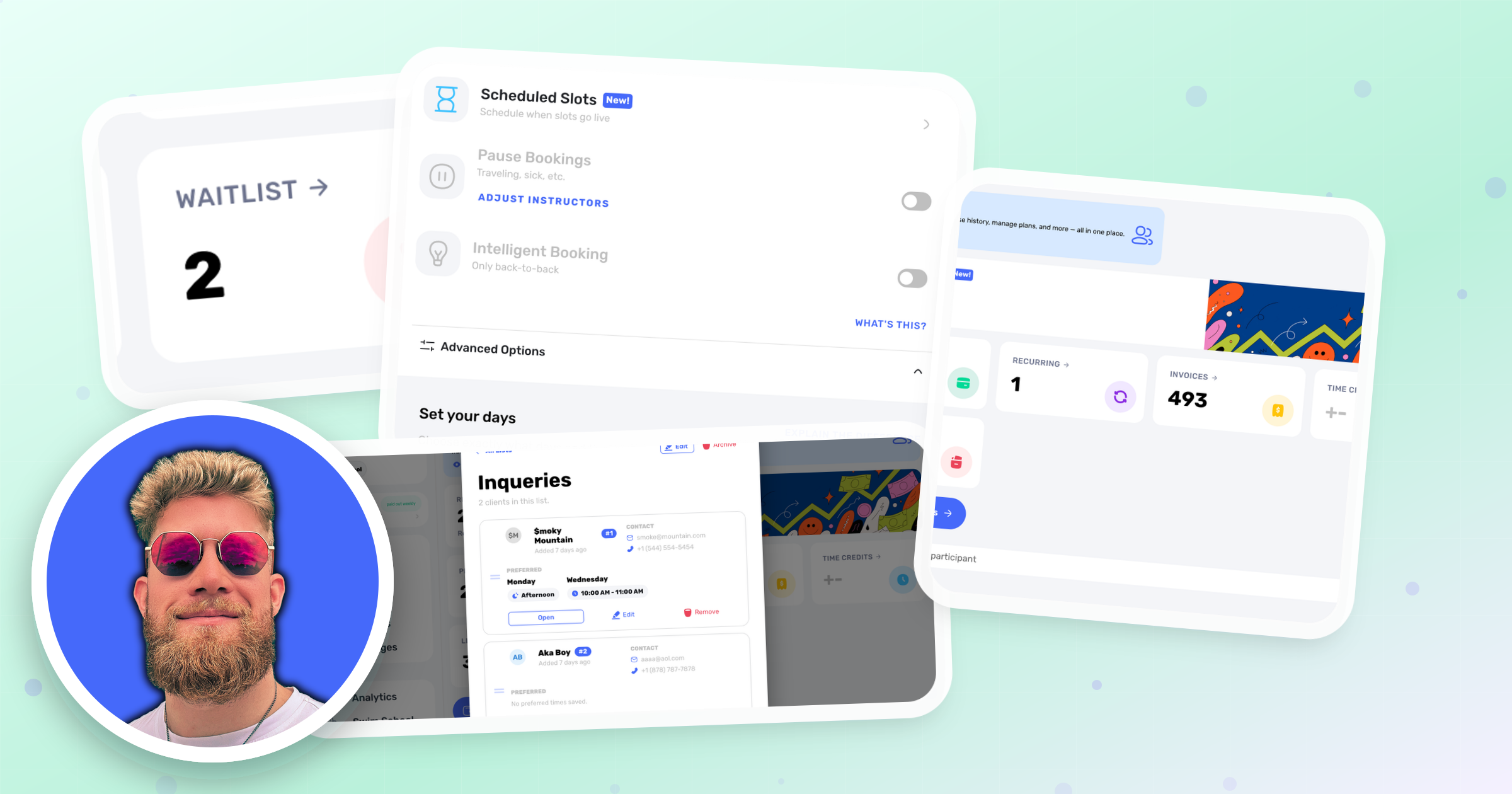
If you'd rather not maintain the spreadsheet, Swum's coach waitlist manager does this natively: add families manually as inquiries come in, keep their details and position in one card, and reorder, open, or archive entries as things change.
Ordering the List: First-Come vs. Fit-First
Every waitlist needs an ordering rule, and there are really only two honest options.
First-come, first-served is maximally fair and maximally defensible - "you're #4 in line" is a sentence nobody argues with. The weakness: the next family in line often can't take the slot that opened. You burn days offering a Tuesday-4pm opening to three families who only do weekends, while the slot sits empty.
Fit-first offers each opening to the earliest family who matches it - right age, right level, compatible schedule. Slots fill faster and stay filled, because the family actually wanted that time. The weakness: it's harder to explain ("the Nguyens joined after us and got in first?"), so it demands transparency.
The honest answer is fit-first with first-come as the tiebreaker - and saying so out loud. The wording that works:
"We offer openings to the earliest waitlisted family that matches the open spot's age, level, and time. Joining earlier means more chances, but a flexible schedule is the fastest way in."
That last clause does double duty: it's true, and it nudges families to widen their availability - which makes your whole list more convertible. A waitlist manager that lets you reorder entries directly makes this rule cheap to operate.
Working the List When a Spot Opens
A waitlist only produces revenue at the moment a spot opens - and most schools fumble exactly here, with open-ended offers that let one slow-replying family hold a slot hostage for a week. Run it like a process:
- Offer to the best-fit family with a deadline. "A Tuesday 4:00pm spot just opened for Maya's level. Want it? I need a yes by tomorrow at 6pm before I offer it to the next family." Specific slot, specific deadline, next-step named.
- 24-48 hour response windows. Long enough for two working parents to compare calendars; short enough that the slot doesn't decay. Use 24 hours for high-demand times, 48 for the rest.
- A stated skip rule. No reply by deadline = the offer moves on, and the family keeps their place in line for the next opening. Skipped twice with no response? Move them to an archive or "cold" status - not deleted, just no longer holding up live offers. (Archiving instead of deleting matters: cold families warm back up in September.)
- Convert with a payment, not a promise. A verbal yes is not a filled slot. The spot is theirs when the booking and payment - or at minimum a deposit - are done. Send the booking link in the offer message itself so "yes" and "paid" happen in the same five minutes.
Done this way, a churned slot refills in 1-3 days instead of weeks - and families experience your waitlist as a machine that works, which keeps the rest of them patient.
Converting the Waitlist to Revenue Now
The biggest waitlist mistake is treating it as a queue for one product - "a weekly private at a prime time" - when it's really a pool of demand you can serve in other ways today:
- Off-peak offers. Your 4-6pm weekday slots are full; your 10am and 1pm slots aren't. Offer waitlisted families the off-peak slot now with first claim on a prime slot when one opens. Some say yes immediately - that's revenue this week from a list that was earning nothing.
- Semi-private pairing. Two waitlisted kids of similar age and level can share one slot as a semi-private lesson - both families get in months sooner, and the slot earns more per hour than the private it replaced.
- Group seeding. Six waitlisted beginners in the same age band is not a waitlist - it's a group class that hasn't been scheduled yet. Pre-sold demand means you can announce the class with most seats already spoken for.
- Deposits to hold a place. For families who want a guaranteed near-term spot, a small deposit (applied to their first package) converts "interested" into "committed" - and tells you exactly who's real when you're deciding whether to expand.
Each of these turns waiting families into paying families without a single new marketing dollar.
Your Waitlist Is Your Expansion Business Case
Most owners agonize over expansion - another instructor, more pool time, a second location - with gut feel and hope. A structured waitlist replaces the guess with arithmetic:
12 families waiting for weekday afternoons × ~$240/month each = ~$2,880/month in pre-sold demand. If an additional instructor for those hours costs you $1,400/month in wages and pool time, the decision stops being brave and starts being obvious - the demand is already captured, contactable, and warm.
Practical signals to act on:
- Waitlist exceeding ~20-25% of active enrollment sustained over a couple of months: you're under capacity, and it's costing you.
- Demand clustered at specific times (the eternal weekday-4-to-6 crunch): add capacity at those hours - a part-time instructor for the after-school block beats a full-time generalist.
- Demand clustered at a level (a beginner pile-up): a level problem, not an hours problem - seed a new beginner group.
- Date-added data showing acceleration: if the list grew faster this quarter than last, expand ahead of the curve, not behind it.
When the numbers say grow, the bottleneck is usually instructor onboarding - schedules, pay, and accountability for staff you barely have time to train. That's the problem swim school instructor management tooling exists to absorb, and your analytics should make the demand side of the case a five-minute pull rather than a weekend project.
Keep Waitlisted Families Warm
A family that hears nothing for six weeks hasn't been waiting - they've been shopping. Silence is how waitlists die. The cadence that keeps them warm without pestering:
- Immediately on joining: Confirm they're on the list, state your ordering rule, and set an honest expectation ("most families are offered a spot within 4-8 weeks; flexible schedules go faster").
- Every 3-4 weeks: A short pulse - "Still on the list, still want a spot? Reply with any schedule changes." This keeps your data fresh and prunes ghosts before they cost you an offer cycle.
- When anything changes: New class forming, off-peak opening, position improving - the touchpoint is news, never noise.
- While they wait, be useful: Send your water-safety basics, what the science says about water anxiety, what to expect at lesson one. Useful content keeps you their default choice when the offer finally comes.
A school-wide messaging tool makes the every-3-weeks pulse a two-minute batch job instead of an afternoon of copy-paste.
One discipline ties all of this together: the waitlist gets worked weekly. Same 15-minute slot on your calendar - new inquiries added, stale entries pulsed or archived, open slots matched against the list. A waitlist you touch weekly is a revenue pipeline. One you touch when you happen to remember is a notes app with extra guilt.
FAQ
How do you manage a swim school waitlist?
Capture structured info at intake (child's age and level, schedule flexibility, format, date added, contact preference), order the list by fit with first-come as the tiebreaker, and work it on a weekly schedule. When a spot opens, offer it to the best-fit family with a 24-48 hour deadline and move on if they don't reply.
What information should a swim lesson waitlist collect?
At minimum: child's name, age, and skill level; the family's schedule availability; desired lesson format (private, semi-private, or group); contact info and preferred channel; date added; and any sibling or referral notes. Schedule flexibility is the single most important field, because it determines who can actually take an opening.
Should a swim school waitlist be first-come, first-served?
Pure first-come is fair but slow, because the next family in line often can't take the specific slot that opened. Most schools do better offering each opening to the earliest family who fits its age, level, and time - and stating that rule openly so nobody feels jumped.
How long should I give a family to claim an open swim lesson spot?
24-48 hours works best: 24 for high-demand prime slots, 48 for everything else. If they don't respond by the deadline, offer the spot to the next fit and keep the non-responder in line for the next opening.
How can I make money from a waitlist before spots open?
Offer off-peak times now with priority on prime slots later, pair compatible waitlisted kids into semi-private lessons, seed new group classes from clusters of similar-level swimmers, and take small deposits that hold a place and apply to the first package.
When does a waitlist justify hiring another swim instructor?
When sustained waitlist demand exceeds roughly 20-25% of your active enrollment, or when the monthly revenue of waiting families clearly covers the cost of added instructor hours and pool time. Concentrated demand at specific times usually means adding targeted hours, not a full-time hire.
Stop letting "we're full" end the conversation. Create your free Swum account and run your waitlist, booking, and payments in one place - or see how the full toolkit fits together on the swim school software page.