Water anxiety affects millions of children, but groundbreaking neuroscience research from 2020-2025 reveals why some kids freeze at the pool edge while others dive right in. For swim school owners, this isn't just about compassion—it's about tapping into a $4.82 billion market growing at 7.2% annually, where specialized anxiety programs can improve retention rates by 20-25% and command premium pricing.
When a child's fear center hijacks their ability to learn, understanding the neuroscience can transform both student outcomes and business success.
Your student's brain on fear
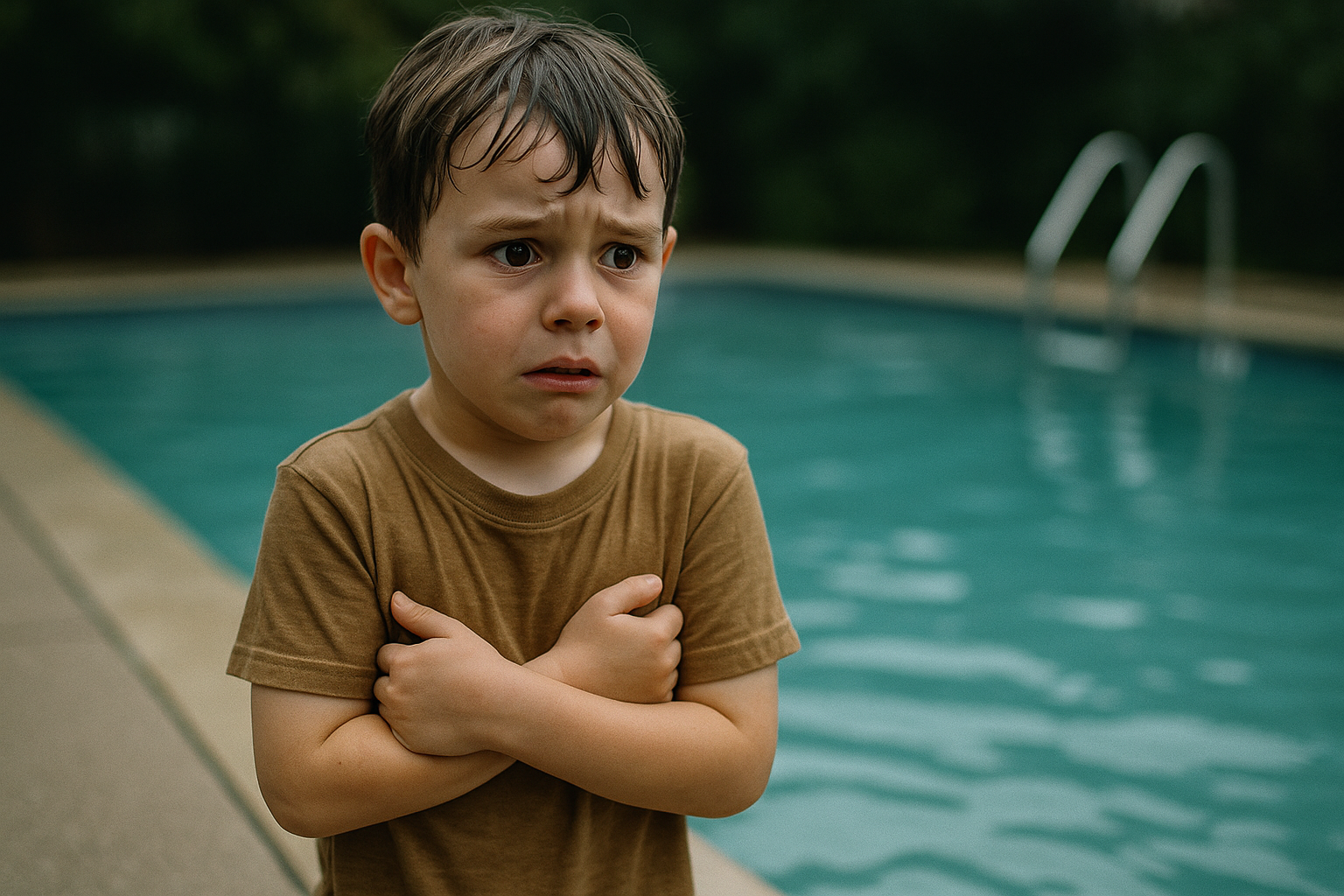
Recent Stanford University research discovered something remarkable: anxious children show stronger one-way signals from their amygdala (fear center) to their prefrontal cortex (rational thinking area). This means fear literally hijacks the decision-making part of the brain, making it neurologically impossible for an anxious child to "just get in the water" through willpower alone.
The implications are profound for swim instruction. When 10-year-old Sarah stands frozen at the pool edge, her amygdala has detected a threat and flooded her system with cortisol and adrenaline. Her hippocampus links this fear to the specific pool environment, while her underdeveloped prefrontal cortex struggles to override the alarm bells. This isn't defiance—it's neurobiology.
University of Ljubljana researchers identified three distinct fear categories that children experience: fear of water contact (especially face submersion), fear of water's natural force (waves, currents), and fear of motion control (losing bodily control in water). Understanding which category drives each child's anxiety allows instructors to target interventions more precisely.
The brain's fear network develops unevenly across childhood. In toddlers, the amygdala develops before the prefrontal cortex, creating a period of hyperawareness without cognitive coping skills. This explains why 27% of toddlers are initially cautious but fine once acclimated, according to industry research. Preschoolers face peak vulnerability for developing specific phobias as their creativity outpaces their ability to distinguish reality from imagination—leading to fears about pool drains or underwater "monsters."
Recognizing the signs before they escalate
Effective swim schools become experts at spotting water anxiety before it becomes entrenched. Physical symptoms manifest as hyperventilation before water contact, muscle rigidity preventing floating, heightened startle responses to splashing, and digestive upset before swim activities. These are involuntary biological responses requiring gentle desensitization, not forced exposure.
Behavioral indicators include crying when water touches the face, refusing hair washing, clinging behavior around pools, avoiding previously enjoyed water play, and extreme reactions to accidental splashing. Cognitive signs involve catastrophic thinking about drowning, inability to focus on instruction near water, persistent worry days before swimming, sleep disruption before lessons, and elaborate avoidance strategies.
Boston Children's Hospital research indicates professional help may be needed when fear persists for six months despite gentle exposure, anxiety significantly disrupts daily activities, physical symptoms are severe or prolonged, the child shows regression in other developmental areas, or family functioning becomes significantly impacted.
Evidence-based strategies that actually work
A 2025 scoping review found that video-based peer modeling proves highly effective for children ages six and older. Showing edited videos of similar-aged children successfully overcoming water fears and learning skills enhances self-efficacy more than traditional instruction alone. Start lessons with 5-10 minutes of video observation, allowing children to see peers successfully managing water activities.
Systematic desensitization protocols follow a proven four-phase approach. Phase one involves pre-pool exposure through water images, breathing practice on land, and meeting instructors outside the pool environment. Phase two focuses on pool edge activities—sitting with feet in water, splashing hands while seated, using toys at the pool edge. Phase three introduces shallow water entry with instructor support, standing in waist-deep water maximum, practicing supported movements. Phase four builds skills gradually with progressive reduction of support aids.
Research shows environmental equipment modifications significantly help anxious children. Goggles allow eyes open underwater, reducing fear. Pool noodles provide security while permitting movement. Appropriate flotation devices offer graduated support that decreases over time. Importantly, these tools benefit children with fear but not those without fear, suggesting individualized equipment strategies.
Cognitive-behavioral techniques address anxiety thought patterns directly. Transform "I will drown" into "The water holds me up and my instructor is here." Replace "I can't breathe" with "I can control my breathing and come up for air anytime." Counter "Something will pull me down" with "I can touch the bottom or edge whenever I need to." External focus instructions—"Push the water back" rather than "Pull your hands back"—prove more effective than internal body-focused cues.
Game-based approaches that reduce anxiety naturally
Structured play activities create non-threatening skill introduction. "Simon Says" water edition, treasure hunts using floating toys, "Red Light/Green Light" for safe stopping and starting, and "Ring Around the Rosie" naturally include submersion. These games work because they engage children's attention externally rather than on their anxiety.
Occupational therapy-informed approaches target sensory integration through deep pressure activities, proprioceptive input via wall push-offs, vestibular input through spinning activities, and tactile exploration with different textured toys. Motor planning activities using simple obstacle courses and sequenced movement games help children feel more in control of their bodies in water.
Implementing anxiety programs for business success
Staff training represents the foundation of successful programs. Swim Whisperers® Adaptive Aquatics Certification offers four progressive levels focusing on different challenges, completed over 90 days with one-year material access. The program includes video content, case studies, practical experience, and CEU approval from major organizations. Group discounts make training multiple instructors cost-effective.
American Red Cross training emphasizes caring, patient, safe instruction for timid swimmers, focusing on comfortable environment creation and progressive skill building. Key training components include assessment skills for identifying anxiety sources, adaptive strategies for different fear triggers, communication methods using positive mantras, sensory management to prevent overload, and progressive techniques building from basic comfort to advanced skills.
Successful programs follow proven implementation models. Swim Angelfish's therapeutic assessment identifies underlying roadblocks before applying targeted strategies. Goldfish Swim School's Science of SwimPlay® system uses play-based learning in 90°F pools with tropical atmospheres. SafeSplash's S.A.F.E.R.™ curriculum accommodates various needs including severe autism through patient instructors and accommodation protocols.
Research from analyzing 14,012 swim school enrollment records found 4% of children reported negative prior aquatic experiences significantly impacting learning outcomes. Including anxiety screening on enrollment forms and sharing with instructors becomes essential for proper program placement.
The business case for specialization
Financial impact proves substantial. Specialized anxiety programs command 15-30% price premiums, with private anxiety lessons earning $60-100 per session versus $25-40 for group lessons. Improved retention adds $200-500 per student annually. Referral increases of 25-40% typically come from satisfied anxiety program families, since 93% of customers trust family recommendations over other advertising.
Initial investments include staff training costs of $200-800 per instructor per level, program development ranging $2,000-5,000, specialized equipment costing $1,000-3,000, and facility modifications for comfortable temperatures adding $200-500 monthly. However, ROI typically achieves within 6-12 months, with break-even occurring when programs maintain 20+ specialized students monthly.
Revenue scales predictably by program size. Small programs with 5-10 anxiety students generate $10,000-20,000 additional annual revenue. Medium programs with 20-30 students produce $30,000-60,000 additional revenue. Large programs with 50+ students create $75,000-150,000+ additional annual revenue.
Customer satisfaction metrics improve dramatically with specialized programs. While industry benchmarks show 80% customer satisfaction rates, anxiety programs achieve higher satisfaction due to individualized attention. Positive word-of-mouth becomes the primary marketing driver, reducing customer acquisition costs significantly.
Case studies demonstrating transformation
Academic research analyzing hundreds of children with negative experiences found boys, children with medical conditions, and public school attendees more likely to report anxiety, significantly impacting learning achievement levels. However, systematic interventions prove highly effective.
One Swim Angelfish case study involved "Peter," experiencing extreme anxiety with rigidity around swimming concepts. Interventions included home video watching of others swimming, purposeful work in both deep and shallow areas, and mantra introduction with reassuring statements. Results showed successful anxiety overcome and swimming skills learned, demonstrating how systematic desensitization combined with positive reinforcement works.
SafeSplash customer testimonials demonstrate adults overcoming lifelong fears, children with autism successfully accommodated, strong instructor retention leading to consistency, and high customer satisfaction with return rates. Their 150+ locations maintain consistent quality through systematic training approaches.
Measuring success and continuous improvement
Success metrics include comfort in water environment, willingness to follow instructions, decreased reliance on flotation aids, independent basic water skills, and positive attitudes toward water activities. Red flag indicators requiring additional support include no improvement after 8-10 sessions, increased anxiety or regression, physical symptoms of severe distress, or expressed trauma history requiring professional intervention.
Quality assurance protocols ensure enhanced supervision ratios for anxious swimmers, emergency action plans specific to anxiety responses, regular staff training updates, incident reporting and analysis systems, and appropriate insurance coverage. Continuous improvement involves regular family feedback collection, instructor performance evaluations, program outcome analysis, industry best practice monitoring, and professional development investment.
Implementation roadmap for swim schools
Begin with foundation building in months 1-3: train core instructors in anxiety management, develop intake and assessment processes, create marketing materials, establish pricing structures, and set up tracking systems. Launch programs in months 4-6 by accepting anxiety students, implementing referral programs, starting content marketing, establishing community partnerships, and monitoring initial outcomes.
Growth and optimization in months 7-12 involves expanding instructor training, refining programs based on results, scaling successful marketing channels, developing advanced offerings, and preparing for expansion. Expected results include basic infrastructure by month 3, initial outcomes by month 6, word-of-mouth referrals impacting enrollment by month 9, and full ROI achievement by month 12.
Conclusion: Science-backed compassion drives profits
Understanding the neuroscience of children's water fears transforms swim instruction from guesswork into evidence-based practice. When swim schools recognize that anxiety represents genuine neurobiological responses requiring patience rather than pressure, they unlock both improved student outcomes and significant business opportunities.
The research consistently demonstrates that specialized anxiety management approaches lead to higher customer satisfaction, increased retention rates, premium pricing capabilities, and substantial revenue growth. Success requires initial investment in training and program development, but the ROI typically appears within 6-12 months through improved retention, referral generation, and market differentiation.
Swim schools positioning themselves as leaders in anxiety management and adaptive instruction are optimally positioned for sustained growth in an expanding market increasingly valuing inclusive, personalized approaches to aquatic education. The science is clear: when you help anxious children succeed in water, everyone wins.
Want to make it seamless for parents to book anxiety-focused lessons? Swum handles specialized scheduling and tracks progress.