Quick answer: if you only get one teaching certification, get the American Red Cross Water Safety Instructor (WSI). It's the most widely recognized credential in US learn-to-swim, typically runs about $250-$400, and combines online coursework with in-water training.
But WSI isn't the only path, and depending on who you teach - toddlers, competitive swimmers, adults - a different credential may fit better. This guide compares the main US options factually, covers the CPR and lifeguarding question, and explains what certification actually does for your business (spoiler: it's less about legality and more about insurance, facilities, and parent trust).
One caveat before the comparisons: prices, formats, and course lengths change. Treat every number here as a 2026 ballpark and confirm details on the provider's current site before you enroll.
Do You Legally Need a Certification to Teach Swimming?
In most of the US, no. There is generally no state license required to teach private swim lessons, the way there is for, say, cutting hair.
But "legally optional" is misleading, because three groups effectively require certification anyway:
- Insurers. Liability policies with aquatics coverage are cheaper and easier to get with recognized credentials - and some underwriters require CPR certification outright.
- Facilities. Most pools that rent lane time to instructors require proof of certification (often lifeguarding and/or a teaching cert) plus insurance before you touch their water.
- Parents. You're asking families to hand you their child in an environment where drowning is the leading cause of death for ages 1-4. "Are you certified?" is one of the first questions serious parents ask.
So the practical answer: treat certification as mandatory. It's also one of the cheapest line items in starting a swim lesson business - usually a few hundred dollars against a skill you'll charge $35-$70 per half hour for.
The Foundation Layer: CPR, First Aid, and Lifeguarding
Before comparing teaching certifications, get the table stakes straight.
CPR/First Aid: non-negotiable
Every swim instructor needs current CPR/AED and First Aid certification - ideally a pediatric-inclusive course if you teach kids. Available from the Red Cross, American Heart Association, and others; typically $40-$120 and a few hours, with renewal every 1-2 years. No insurer, facility, or informed parent will accept its absence.
Lifeguard certification vs. teaching certification
These are different credentials, and new instructors mix them up constantly:
- Lifeguard certification trains you to surveil, rescue, and respond. Roughly $200-$400 and 20-30 hours, typically valid for 2 years.
- Teaching certification (WSI and peers) trains you to actually teach swimming: progressions, skill analysis, lesson planning, class management.
A lifeguard cert does not qualify you to teach; a teaching cert does not qualify you to guard. Many rental facilities require lifeguarding (or a guard on deck) regardless of your teaching credential, so if you plan to rent lanes, plan on holding both.
The Main US Teaching Certifications Compared
| Certification | Approx. Cost | Approx. Time | Recognition | Best For |
|---|---|---|---|---|
| Red Cross WSI | $250-$400 | ~25-30 hrs (blended online + in-water) | Highest in US | The default choice; broadest facility acceptance |
| ASCA Learn-to-Swim / coaching levels | Varies by level (often ~$100-$300 per level) | Self-paced coursework | Strong in coaching/competitive circles | Instructors heading toward swim team coaching |
| Starfish Aquatics (Starfish Swimming / StarGuard) | Varies by program | Course + practical components | Established with facilities and waterparks | Instructors at Starfish-affiliated facilities; risk-management focus |
| USMS / Masters-oriented (e.g., ALTS instructor training) | Varies | Course + practical | Niche but respected | Teaching adult learners and adult-fitness swimmers |
| YMCA swim instructor training | Often low-cost or employer-paid | In-house program | Recognized within Y network | Instructors employed at a YMCA |
Again: confirm current pricing and formats with each provider - all of these evolve year to year.
American Red Cross WSI: the default
The Water Safety Instructor certification is the closest thing US learn-to-swim has to a standard. The blended-learning format pairs online coursework with in-water precourse skills and instructor-led sessions, covering teaching progressions from parent-and-child through adult learners.
Why it wins for most independent instructors: recognition. Facilities know it, insurers know it, and parents who research at all will see it everywhere. If your plan is private or mobile instruction, WSI is the credential that opens the most doors per dollar.
Note the prerequisites: minimum age (typically 16) and demonstrated swim skills. Budget for a possible precourse skills session.
ASCA: the coaching ladder
The American Swimming Coaches Association offers leveled certifications spanning learn-to-swim through elite coaching. The coursework is self-paced and the levels create a visible progression ladder.
ASCA shines if your trajectory points toward competitive coaching - stroke refinement, swim team prep, club coaching - or if you want a credential that signals depth beyond beginner lessons. Many instructors stack it on top of WSI rather than instead of it.
Starfish Aquatics: facility and risk-management roots
Starfish Aquatics Institute runs both swim instruction (Starfish Swimming) and lifeguarding (StarGuard) programs, with a strong emphasis on risk management and quality systems. You'll encounter it most at affiliated facilities, waterparks, and swim schools that license the curriculum. If your employer or rental facility runs Starfish programming, certifying within their system is the natural move.
USMS and adult-focused training
US Masters Swimming supports adult-learn-to-swim instruction (their ALTS initiative) and adult coaching education. If your niche is teaching adults - a market most instructors ignore, and one that pays premium rates - adult-specific training teaches things WSI's kid-centric material touches lightly: fear management, adult biomechanics, and dignity-first teaching.
YMCA in-house training
The Y trains its own instructors to deliver its proprietary curriculum, often at low or no cost to employees. It's a great paid entry point into teaching - just know it's primarily recognized within the Y network. If you later go independent, plan to add WSI for portability.
Which Certification Should You Get? (By Goal)
- "I want to teach private lessons to kids." WSI + CPR/First Aid. Add lifeguarding if your facility requires it.
- "I want to coach a swim team eventually." WSI now, ASCA levels as you grow.
- "I want to teach adults." WSI as the base, plus USMS/ALTS-style adult training.
- "I work at a Y / Starfish facility." Their in-house program first (often free), WSI when you want portability.
- "I'm not sure yet." WSI. It's the most transferable answer.
What Parents Actually Ask About
Here's the honest hierarchy of what parents care about, based on what they ask before booking:
- "Are you CPR certified?" - the most common safety question by far.
- "Are you certified to teach?" - they rarely know one credential from another; they want a confident yes with a recognizable name. "Red Cross certified" lands instantly.
- "How long have you been teaching?" - experience and reviews often outweigh credentials after your first season.
- "Are you insured?" - asked less often than it should be, but the serious buyers ask.
The implication: certifications get you into the consideration set; warmth, results, and word of mouth win the booking. Don't over-invest in a wall of credentials before you've taught your first hundred lessons.
Put Your Credentials Where Parents Can See Them
A certification nobody sees does half its job. Three places it should live:
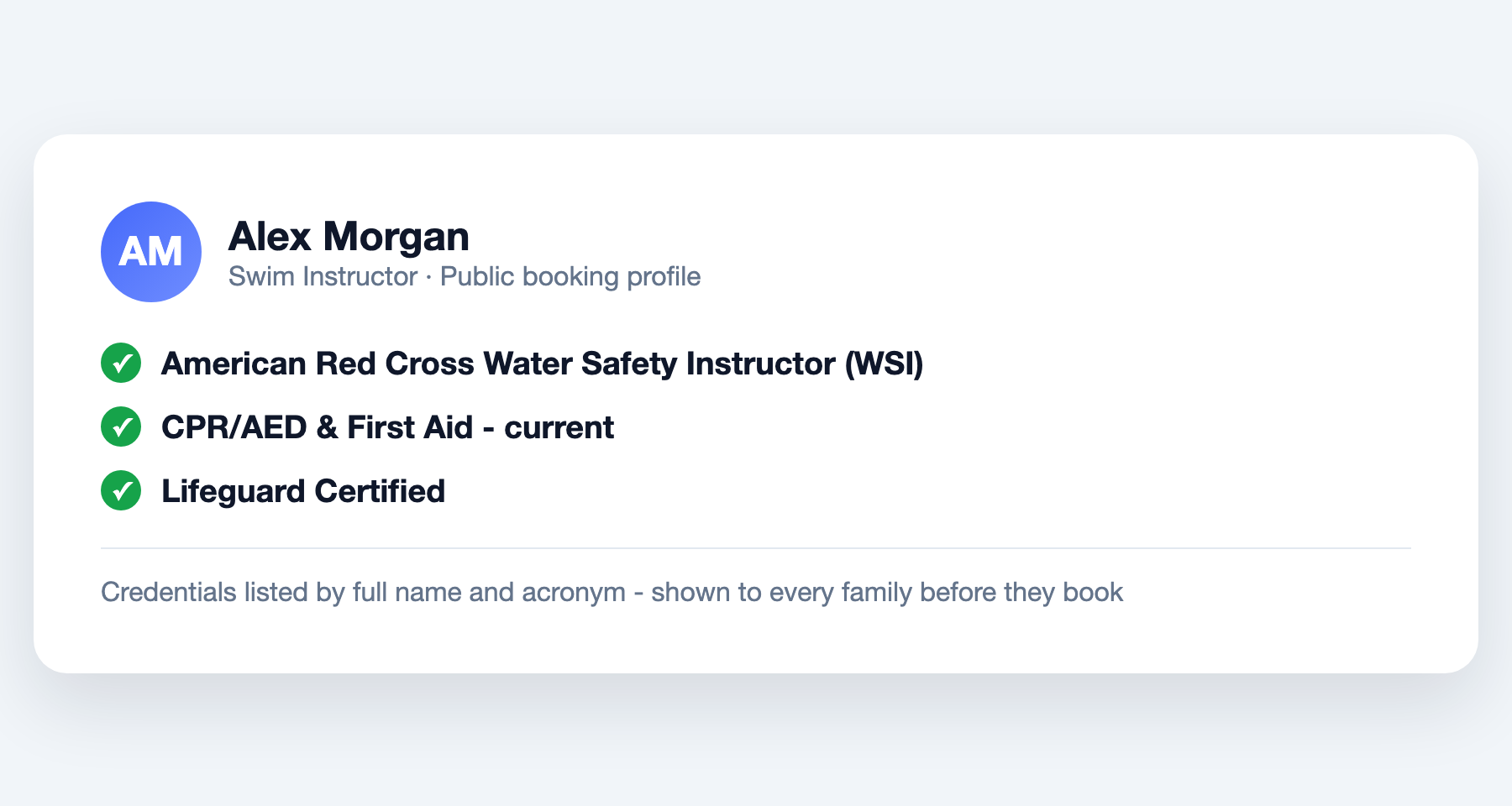
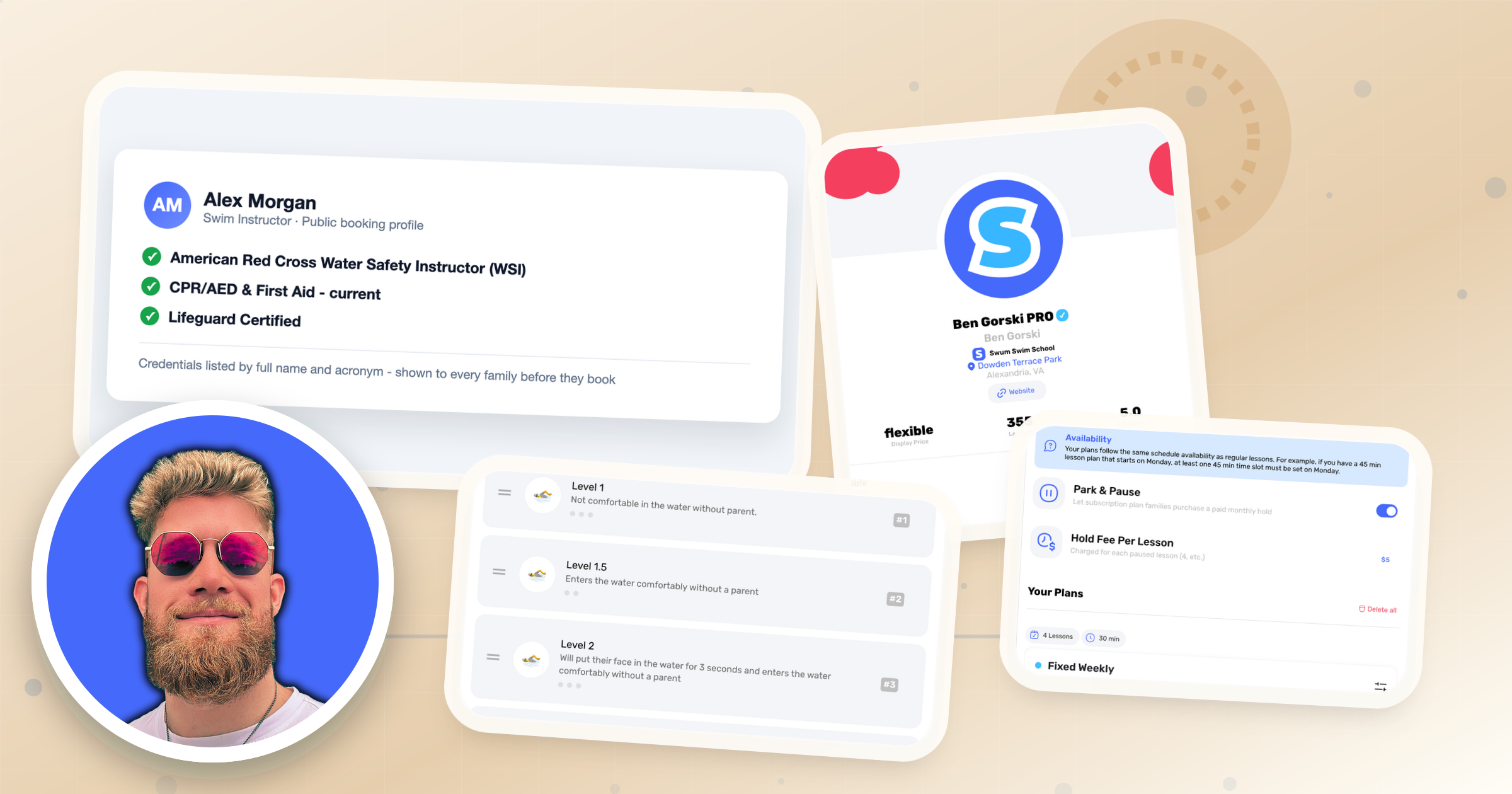
- Your booking page. List certifications by full name and acronym - "American Red Cross Water Safety Instructor (WSI), CPR/AED & First Aid certified" - right next to your bio and rates. On Swum, your public profile is also how families browsing find a swim instructor compare you to other local instructors, and credentials are a primary differentiator there.
- Your waiver and policy documents. Parents read your waiver at their most safety-conscious moment. A credentials line there reinforces trust exactly when it matters.
- Your marketing. Flyers, Facebook group replies, your email signature. "Certified" is one word that pre-answers the biggest objection.
And keep renewals current - an expired cert is worse on a booking page than no mention at all. Most teaching certs renew every 1-3 years; CPR every 1-2.
Certification Is Step One, Not the Finish Line
A weekend of in-water training makes you certified, not experienced. The fastest-improving new instructors do three things:
- Teach early and often - even free lessons for friends' kids while your cert is in progress builds the reps that actually make you good.
- Shadow a veteran for a few sessions; you'll absorb more class management in three hours of watching than thirty hours of coursework.
- Keep learning the science - understanding things like why water fear is rational and how toddler breath control develops is what separates instructors who recite progressions from ones who adapt them.
From there, the path is the same as every independent instructor's: insurance, water, rates, booking, clients. Our new instructor hub and the step-by-step business guide cover the rest.
FAQ
What certification do you need to be a swim instructor?
No US state legally requires one, but the practical standard is CPR/First Aid plus a recognized teaching certification - most commonly American Red Cross Water Safety Instructor (WSI). Insurers, rental facilities, and parents all effectively expect it.
How much does WSI certification cost?
Red Cross WSI typically costs around $250-$400 in 2026, depending on the local provider, and combines online coursework with in-water instruction. Check current pricing with your local Red Cross training provider, and budget separately for CPR/First Aid.
How long does it take to become a certified swim instructor?
Most instructors complete CPR/First Aid plus a WSI-level teaching certification in 4-8 weeks, with roughly 25-30 hours of combined online and in-water coursework for the teaching credential itself.
Is a lifeguard certification the same as a swim instructor certification?
No. Lifeguard certification covers surveillance, rescue, and emergency response; a teaching certification like WSI covers how to teach swimming. Many facilities require instructors to hold both, but neither substitutes for the other.
Can you teach swim lessons without being certified?
Legally yes in most states, but practically no: most pools won't rent you lane time, insurers may not cover you affordably, and many parents won't book an uncertified instructor. Certification costs a few hundred dollars against rates of $35-$70 per half-hour lesson.
Which swim instructor certification is best?
American Red Cross WSI is the most recognized and most portable US credential, making it the best default. Add ASCA levels if you're heading toward competitive coaching, or USMS-style adult-learn-to-swim training if you specialize in adult students.
Certified and ready to take your first booking? Create your free Swum account to put your credentials on a professional booking page today - and see the new instructor resources for everything that comes next.