Mobile swim instruction is the highest-rate, lowest-overhead way to teach swimming. No lane rental, no facility, and parents pay a premium because you show up at their pool.
It's also the easiest swim business to run unprofitably. The instructor charging $90 a lesson but driving 40 unpaid minutes between every stop is earning less per hour than the one charging $55 at a fixed pool.
The difference between those two outcomes isn't your rate. It's three operational decisions: how you price travel, where you agree to go, and what order you go there in. This guide covers all three.
(If you haven't set your base lesson rate yet, start with our 2026 swim lesson pricing guide - this article builds on top of it.)
The Mobile Premium: What to Charge for Showing Up
At-home lessons in the US typically run 20-50% above pool-based rates in the same market. If local pool-based privates go for $60, mobile instructors in that market are charging $75-$90 for the same 30 minutes.
You have two ways to capture that premium:
- Bake it into your rate. One mobile price, travel included. Simple to communicate, but it means a family 5 minutes away subsidizes the family 35 minutes away - and you have no fair way to say yes to the far ones.
- Charge a base rate plus an explicit zone surcharge. Your rate stays competitive on the booking page, nearby families pay little or nothing extra, and distant families pay for the distance they actually create.
For most mobile instructors, the hybrid wins: a modest built-in premium (10-20% over local pool rates) plus zone surcharges for anything outside your core area. It reads as fair, and it lets you serve the outer suburbs profitably instead of refusing them.
Whatever you choose, never present travel pricing as an apology. Parents paying for at-home lessons are buying convenience - no packing the car, no locker rooms, kids learning in the water they'll actually swim in all summer. That convenience is the product.
Zone Design: Core, Middle, Outer
A service zone map is the single highest-leverage pricing tool a mobile instructor has. The standard structure is three rings around your home base:
| Zone | Drive time from base | Surcharge | Booking rules |
|---|---|---|---|
| Core | 0-15 min | $0 | Any duration, any day |
| Middle | 15-30 min | +$10-$15 per visit | 45-min minimum, or sibling back-to-back |
| Outer | 30-45 min | +$20-$35 per visit | 60-min minimum per stop, specific days only |
| Beyond | 45+ min | Custom quote or no | Multi-family stops only, if at all |
A worked example with a $70 mobile base rate:
| Booking | Zone | What the family pays |
|---|---|---|
| 30-min lesson, 8 min away | Core | $70 |
| 45-min lesson, 22 min away | Middle | $105 + $12 = $117 |
| Two 30-min sibling lessons, 38 min away | Outer | $140 + $25 = $165 |
Notice the outer-zone family isn't being punished - they're paying roughly what the stop actually costs you to serve, and the sibling minimum turns a marginal trip into a worthwhile one.
Zip codes vs. drawn boundaries
You can define zones two ways: by zip code list or by drawing the boundary on a map. Zip codes are fast and easy to publish ("we serve 30303, 30305, 30306..."). Drawn boundaries are more precise - useful when a zip code straddles a river, a highway, or a 25-minute traffic chokepoint that makes half of it impractical.
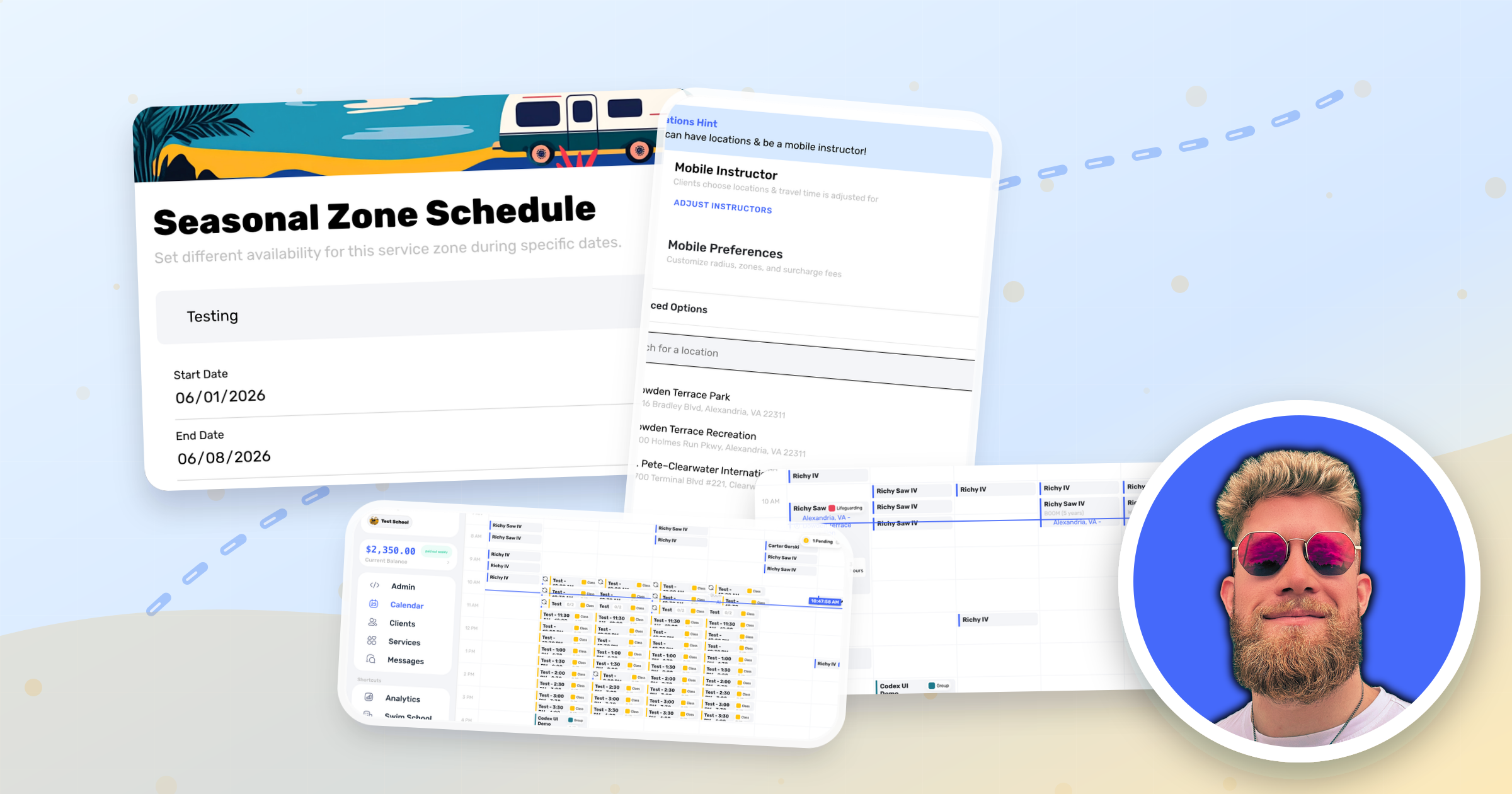
In Swum's mobile instructor tools, you can build zones either way, attach a surcharge to each zone, and the right travel fee is applied automatically when a parent books - no quoting travel by text message, no awkward fee conversations.
The Drive-Time Math That Quietly Kills Margins
Here's the spreadsheet every mobile instructor should run once. Take the same six 30-minute lessons at $80 each - $480 of revenue either way - and look at what changes when they're scattered versus clustered:
| 6 lessons scattered across town | 6 lessons clustered in 2 neighborhoods | |
|---|---|---|
| Teaching time | 3 hrs | 3 hrs |
| Average drive between stops | 25 min | 8 min |
| Total drive time (incl. first/last leg) | ~2 hrs 55 min | ~1 hr 10 min |
| Total working day | ~5 hrs 55 min | ~4 hrs 10 min |
| Miles driven (approx.) | ~70 | ~25 |
| Fuel + vehicle cost (~$0.70/mi all-in) | ~$49 | ~$18 |
| Effective hourly rate | ~$73/hr | ~$111/hr |
Same revenue. Same teaching. The clustered schedule earns roughly 50% more per working hour and frees up almost two hours - enough for two more lessons, which would push the day to $640.
This is why scattered scheduling is the silent killer of mobile swim businesses. Most instructors never see it, because the revenue number looks identical. The cost shows up as exhaustion and a calendar that's "full" at five lessons a day.
Two rules follow directly from this math:
- Distance must be priced (zones and surcharges, above).
- Order must be controlled (routing and clustering, below).
Minimums Per Stop: Never Drive 25 Minutes for 30 Minutes of Revenue
A single 30-minute lesson at the edge of your service area is a money-loser at almost any rate. The fix isn't raising the price to $150 - it's raising the revenue per stop:
- Sibling back-to-backs. Two or three kids from one family, consecutive lessons, one driveway. This is the default mobile booking and you should nudge every multi-kid family toward it.
- Semi-privates. Two kids of similar level in one lesson at a per-swimmer rate. A $50-per-swimmer semi-private beats a $80 solo lesson at the same stop - and parents love splitting the cost with a neighbor.
- Neighbor pods. One family hosts, two or three families attend back-to-back lessons in the same pool. One stop, 90-120 minutes of revenue. Offer the host family a small discount; they'll do your recruiting for you.
- Duration minimums by zone. 60-minute minimum (or two-lesson minimum) in your outer zone, stated plainly in your booking rules. Families either book enough to make the trip worth it or they don't book - both outcomes beat an unprofitable yes.
A simple benchmark: aim for at least 60 minutes of teaching revenue per stop in your middle zone, and 90+ in your outer zone.
Route-Aware Scheduling: Cluster Days by Neighborhood
Pricing fixes the per-stop economics. Routing fixes the per-day economics.
- Assign neighborhoods to days. Mondays north side, Tuesdays the lake suburbs, Wednesdays in-town. Parents adapt to "I'm in your area Tuesdays and Thursdays" far more easily than you'd expect - it reads as a professional with a route, not a limitation.
- Buffer between lessons based on actual drive time, not a flat 15 minutes. A flat buffer is either too short (you arrive flustered and late) or too long (you burn 30 minutes in a parking lot). The buffer should match the real drive between the two addresses.
- Protect the route when new bookings come in. The dangerous booking isn't the far one - it's the 2:00 pm slot that's 25 minutes from both your 1:00 and your 3:00.
Doing this manually means cross-referencing Google Maps every time a parent asks for a slot. This is the specific problem Swum's route-aware availability solves: parents self-book 24/7, but they're only shown times that actually work with the drive times around them, with travel buffers added automatically. Your route stays intact without you playing dispatcher. See how it works on the scheduling page.
Seasonal Zone Shifts: Tighter in Winter, Wider in Summer
Your profitable service area isn't fixed - it moves with demand and daylight.
- Summer: demand is 3-5x winter levels in most US markets, backyard pools are open, and evenings are long. You can profitably serve a wider area because every neighborhood has enough demand to cluster stops.
- School year: demand thins out, lessons compress into the after-school window, and indoor-pool families are scattered. A 35-minute drive that made sense in July for three back-to-back stops makes no sense in October for one.
The mistake is running one zone map all year. Run two: a tight school-year map (core + middle only, stricter minimums) and an expanded summer map (outer ring open, maybe a summer-only zone for the lake community 40 minutes out).
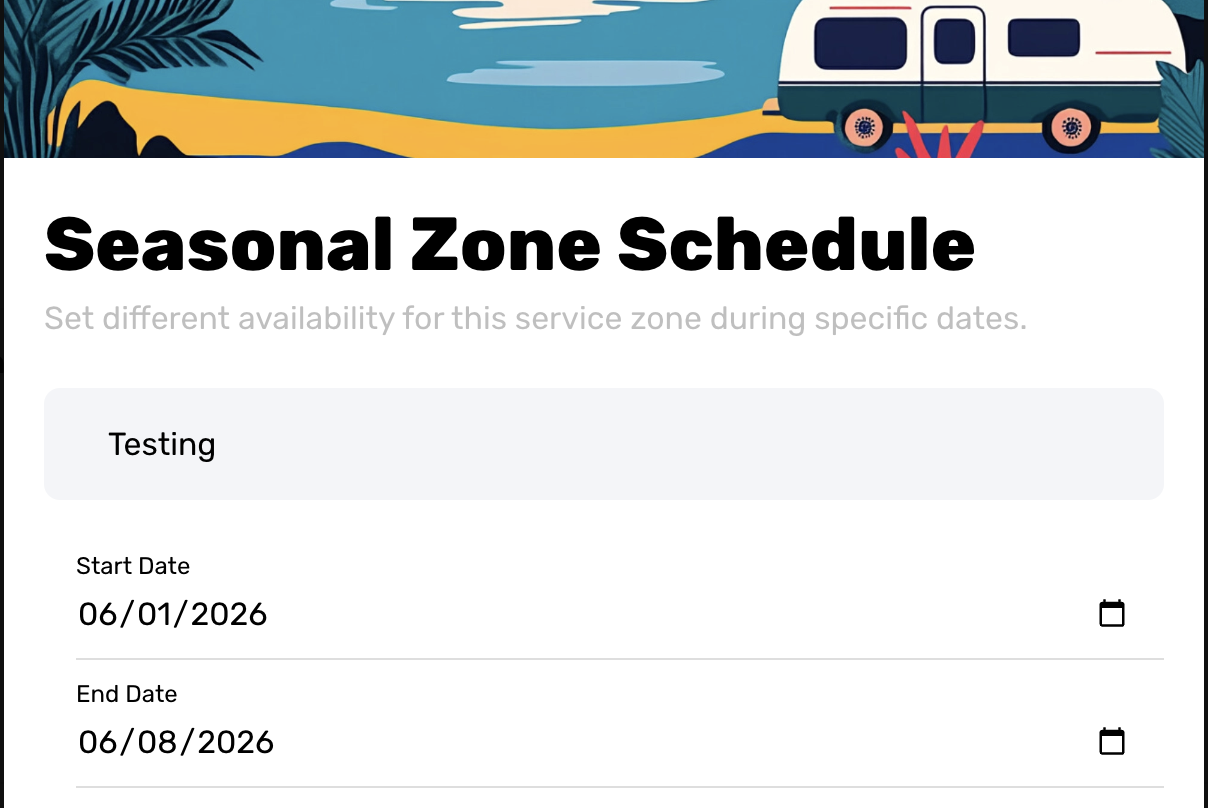
In Swum you can put zones on a seasonal schedule - your summer zones activate and retire on dates you set, so the booking page always reflects where you're actually willing to drive that time of year. (For the bigger seasonal strategy - what to sell and when - that's a whole playbook of its own starting with local marketing.)
The Mobile Gear & Logistics Kit
You're a traveling facility. Build the kit once and restock weekly:
- Teaching gear: 2-3 kickboards, pull buoys, sinking toys/dive rings, a couple of noodles, goggles in two sizes (kids lose theirs constantly - charging $10 for a spare pair is a fine micro-revenue line).
- Safety: a compact rescue tube or flotation aid, a basic first-aid kit, your CPR cert physically in the bag (parents do ask).
- Logistics: mesh gear bag that drains in the trunk, a plastic bin so the car doesn't mildew, towel and dry change of clothes, phone mount for navigation, sunscreen.
- Admin: you shouldn't be carrying paper. Digital waivers signed before the first lesson, card-on-file payments charged automatically, and lesson notes in your phone. The instructor collecting Venmo at the pool ledge looks like a side hustle; the one whose booking, waiver, and payment all happened before they arrived looks like a business.
Insurance Notes for Teaching in Client Pools
Not legal advice - but these are the basics every mobile instructor should have squared away:
- General liability insurance that explicitly covers instruction at third-party/residential locations. Many baseline policies assume a fixed facility; teaching in client pools without the right endorsement can void coverage. Aquatics-specific policies for independent instructors commonly run $300-$700/year - one to two weeks of lessons.
- Professional liability (errors & omissions) layered on top, since you're providing safety instruction.
- A signed liability waiver from every family, every season - stored digitally, not in a glovebox folder.
- A pool-condition check you actually do: working drain covers, gate latches, water clarity, no electrical hazards near the water. If a pool isn't safe to teach in, the lesson doesn't happen. Put that right in your policies so it's never a negotiation poolside.
- Auto coverage reality check: you're driving for business purposes. Tell your auto insurer; a business-use endorsement is usually cheap, and an undisclosed business claim denial is not.
Putting It Together
Price the premium. Draw the zones. Set per-stop minimums. Cluster your days and let routing protect them. Shift the map seasonally. That's the whole operating system of a profitable mobile swim business - and it's worth doing on paper even if you run everything from a notebook.
If you'd rather not run it from a notebook, Swum's mobile instructor software was built around exactly this model: drawn or zip-based service zones, per-zone surcharges, seasonal zone schedules, drive-time-aware availability, and automatic lesson buffers - on a free plan, with paid plans when your volume justifies it.
FAQ
How much should mobile swim instructors charge for travel?
Most mobile instructors charge 20-50% above local pool-based rates, either built into the lesson price or as explicit zone surcharges of roughly $10-$35 per visit depending on distance. A hybrid - a modest built-in premium plus surcharges beyond your core zone - is the most common setup.
How far should a mobile swim instructor travel for lessons?
A practical ceiling is about 45 minutes from base, and only with minimums that justify the trip - typically 60+ minutes of teaching per stop in outer areas. Most of your profitable bookings will come from within 15-30 minutes.
Should I charge more for at-home swim lessons in a client's pool?
Yes. At-home lessons carry real convenience value for families and real travel cost for you, and US market rates reflect that with a 20-50% premium over comparable pool-based lessons.
What is a service zone for a mobile swim business?
A service zone is a defined geographic area - a set of zip codes or a drawn map boundary - with its own pricing and booking rules. Most mobile instructors run a free core zone, a middle zone with a small surcharge, and an outer zone with a larger surcharge plus a per-stop minimum.
Do mobile swim instructors need special insurance?
Yes - general liability coverage that explicitly includes instruction at residential or third-party pools, ideally with professional liability on top. Aquatics-focused policies for independent instructors typically cost $300-$700 per year, and signed waivers from every family are a must.
How do I stop drive time from eating my profits?
Three moves: charge zone surcharges so distance is priced, set per-stop minimums (sibling back-to-backs, semi-privates, or 60-minute minimums in far zones), and cluster lessons by neighborhood on set days. Clustered routing alone can raise your effective hourly rate by 40-50% on identical revenue.
Ready to run your routes instead of your routes running you? Create your free Swum account and set up your zones, surcharges, and travel-aware booking today - or see everything built for traveling instructors on the mobile swim instructor software page.