"How much should I charge?" is the single most common question we hear from instructors - whether they're teaching their first lesson next week or running a multi-pool school.
Here's the short answer for 2026:
Most private 30-minute swim lessons in the US fall between $35 and $70. Experienced instructors in major metros routinely charge $80-$120, and mobile instructors who travel to client homes command the highest rates of all.
But the number on your booking page is only half the story. The format you sell (private vs. semi-private vs. group), the way you bundle (packages and subscription plans), and the fees you pay to get paid all change what actually lands in your bank account.
This guide covers all of it: real rate ranges, the factors that should move you up or down within them, the pricing models that earn more over a season, and - at the end - exactly how to set every piece of this up in Swum in about ten minutes.
Quick Reference: 2026 Swim Lesson Rates
| Lesson Format | Small Town / Rural | Mid-Size City | Major Metro |
|---|---|---|---|
| Private (30 min) | $30-$45 | $40-$60 | $60-$120 |
| Private (45 min) | $45-$65 | $60-$85 | $85-$160 |
| Private (60 min) | $55-$80 | $75-$110 | $110-$200 |
| Semi-private, per swimmer (30 min) | $20-$35 | $30-$45 | $40-$70 |
| Group class, per swimmer per session | $12-$20 | $15-$28 | $25-$45 |
| Mobile / at-home premium | +15-25% | +20-40% | +25-50% |
A few notes on reading this table:
- These are instructor-level rates, not facility drop-in prices. If you teach through someone else's swim school as staff, your wage is a different conversation (see how instructors get paid on Swum).
- "Major metro" means high cost-of-living markets: the Bay Area, NYC, LA, Seattle, Miami, Austin, and similar. In these markets, parents already expect premium pricing for anything involving their kids' safety.
- The mobile premium is on top of the base rate. More on travel pricing below.
The 5 Factors That Set Your Rate
1. Your market, not your self-doubt
The biggest pricing mistake new instructors make is benchmarking against the cheapest group lesson at the local rec center. You are not selling the same product. A parent comparing a $15 group slot at the YMCA to your $60 private lesson is comparing eight kids per instructor to one.
Search what private instructors (not facilities) charge within a 20-minute drive of you. That's your real comp set. Most of your customers live within 25 miles of your pool - swim lessons are a local business, which is also why local marketing beats digital for swim schools.
2. Format: private, semi-private, or group
Private lessons earn the most per booking. Semi-private and group earn the most per hour of your time:
- A $60 private 30-minute lesson = $120/hour.
- A semi-private at $40 per swimmer with 2 swimmers = $160/hour.
- A group of 6 at $25 each for 45 minutes = $200/hour.
The best-earning instructors don't pick one - they run privates as the premium product, semi-private lessons for siblings and friends, and group classes to fill the calendar's soft spots.
3. Experience and credentials
Certifications (WSI, lifeguarding, CPR, coaching certifications) justify the upper half of your market's range - but only if you say so. Put them on your booking page. After 2-3 seasons with a waitlist, you've earned a raise; a full calendar at your current rate is the strongest pricing signal that exists.
4. Location logistics
Who travels, and whose water is it?
- Your pool, clients come to you: baseline rate.
- Client's home pool: add the mobile premium. You're spending unpaid time in the car, and the convenience is worth real money to busy parents.
- Rented facility lane time: build the lane cost into your rate. If lane rental costs you $25/hour and you teach two 30-minute lessons in it, that's $12.50 per lesson that has to live inside your price.
5. Seasonality and demand
Summer demand in most US markets is 3-5x winter demand. You don't need to discount January - you need to sell commitment in May. That's what packages, subscription plans, and registration fees are for (covered below).
Don't Price the Lesson - Price the Outcome
Parents aren't buying 30 minutes of pool time. They're buying a kid who doesn't drown. Learn-to-swim is a safety purchase, and safety purchases are remarkably price-insensitive when trust is high.
Practical implications:
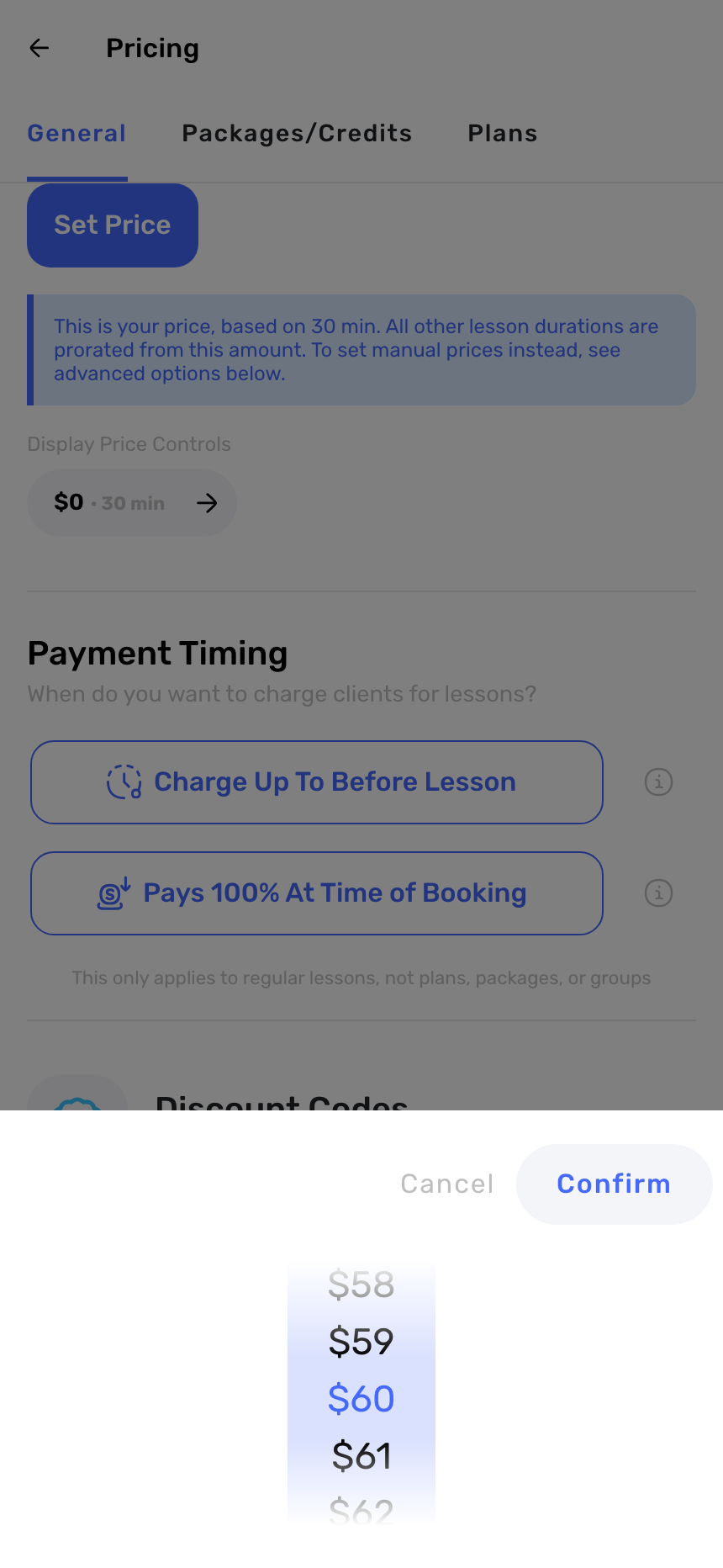
- Round numbers read as confidence. $60 beats $57.
- Never apologize for a rate increase. Announce it with notice and gratitude, not justification paragraphs.
- Anchor with your premium option. When parents see a $200/month unlimited-style plan next to a $60 single lesson, the $480 8-pack in the middle looks reasonable. That's the option most will choose.
Single Lessons vs. Packages vs. Subscription Plans
The rate table above is your sticker price. How you bundle determines your season revenue.
Single (drop-in) lessons - full price, zero commitment. Great for first-timers and trials; terrible as your only product, because every week is a new sales conversation.
Packages - prepaid bundles of lesson credits (e.g., 8 lessons for the price of 7.2). The standard discount for bulk prepayment is 8-15%. Bigger than that and you're giving away margin you don't need to; parents buy packages for commitment and convenience, not deep discounts. Credits with an expiration window (60-90 days is common) protect you from liability sitting on your books forever.
Subscription plans - recurring billing for a weekly spot (e.g., 4 lessons/month, auto-renewed). This is the strongest revenue model in swim instruction: predictable cash flow, a default-continue relationship instead of a default-quit one, and a held spot the family doesn't want to lose. Price plans at roughly the same per-lesson rate as your mid-size package - the value you're trading is the guaranteed recurring slot, not a discount.
A healthy mature book of business looks something like: 60-70% of revenue from plans, 20-30% from packages, and ~10% from singles and trials.
Mobile and At-Home Lesson Pricing
If you travel to client pools, your pricing needs two extra pieces:
- A travel premium or zone surcharge. Either bake 20-50% into your mobile rate, or charge explicit zone-based surcharges (e.g., +$10 inside your core zone, +$25 for the outer ring). Zone surcharges feel fairer to nearby clients and let you serve farther ones profitably instead of refusing them.
- A minimum booking size per stop. A single 30-minute lesson 25 minutes away is a money-loser at almost any rate. Mobile instructors solve this with back-to-back sibling lessons, semi-privates, or 60-minute minimums for far zones.
This is exactly the problem mobile swim instructor software exists to solve - service zones, drive-time-aware scheduling, and per-zone pricing rules so you never manually do this math again.
Your Rate Is Not Your Take-Home: The Fee Math
Here's the part most pricing guides skip. Between payment processing and platform fees, two instructors charging the same $60 can take home very different amounts.
Generic booking platforms typically stack a ~3% card processing fee on top of platform fees, marketplace cuts, or monthly software costs. On Swum, the comparison is simple:
| Swum Standard | Swum Pro | |
|---|---|---|
| Monthly cost | $0 | $98 |
| Total fees on payments | 23% | 5% |
| $60 lesson take-home | $46.20 | $57.00 |
| 20 lessons/week, take-home per month | ~$3,696 | ~$4,462 |
At roughly 9+ lessons a week, Pro pays for itself - and everything above that is a raise you gave yourself without changing your sticker price. Run your own numbers on the pricing page earnings comparison.
Two more take-home levers worth knowing:
- Pass fees to clients. Swum lets you pass the 3% card fee (or all fees) through to the client at checkout. Common for premium instructors; invisible-feeling to parents when the base rate is fair.
- Offer bank (ACH) payments. Cheaper processing than cards on bigger transactions like packages and plans.
Common Pricing Mistakes
- Pricing to your cheapest competitor. The rec center is not your competitor. The other private instructor with a 6-week waitlist is.
- One flat price for every duration. A 60-minute lesson is not worth exactly 2x a 30-minute one - your setup, travel, and admin time don't double. Most instructors price 60 minutes at ~1.8-2x and 45 minutes at ~1.4-1.5x the 30-minute rate.
- Discounting instead of structuring. If you feel pressure to be cheaper, don't cut your rate - add a package tier or a first-lesson offer. A 20% first-lesson discount costs you a few dollars once; a permanently lowered rate costs you every week forever.
- No deposit, no cancellation policy. No-shows are a pricing problem in disguise. A 10% deposit at booking filters out the families who were never serious, and time-credit refunds inside your policy window keep it parent-friendly.
- Eating rate increases for years. Raise rates annually for new clients at minimum. Grandfather loyal families one season behind if you want - but have a written number for "new client rate" that moves every year.
How to Raise Rates Without Losing Families
- Give 30-60 days notice, in writing, with one sentence of reasoning ("to keep lesson groups small and retain great instructors").
- Raise new-client rates first. Existing families come up to the new rate the following season.
- Pair the increase with a visible improvement: progress reports, a better booking experience, makeup-lesson flexibility.
- Expect to lose 0-2 families per 50. If you lose nobody, you waited too long.
Setting All of This Up in Swum (10-Minute Walkthrough)
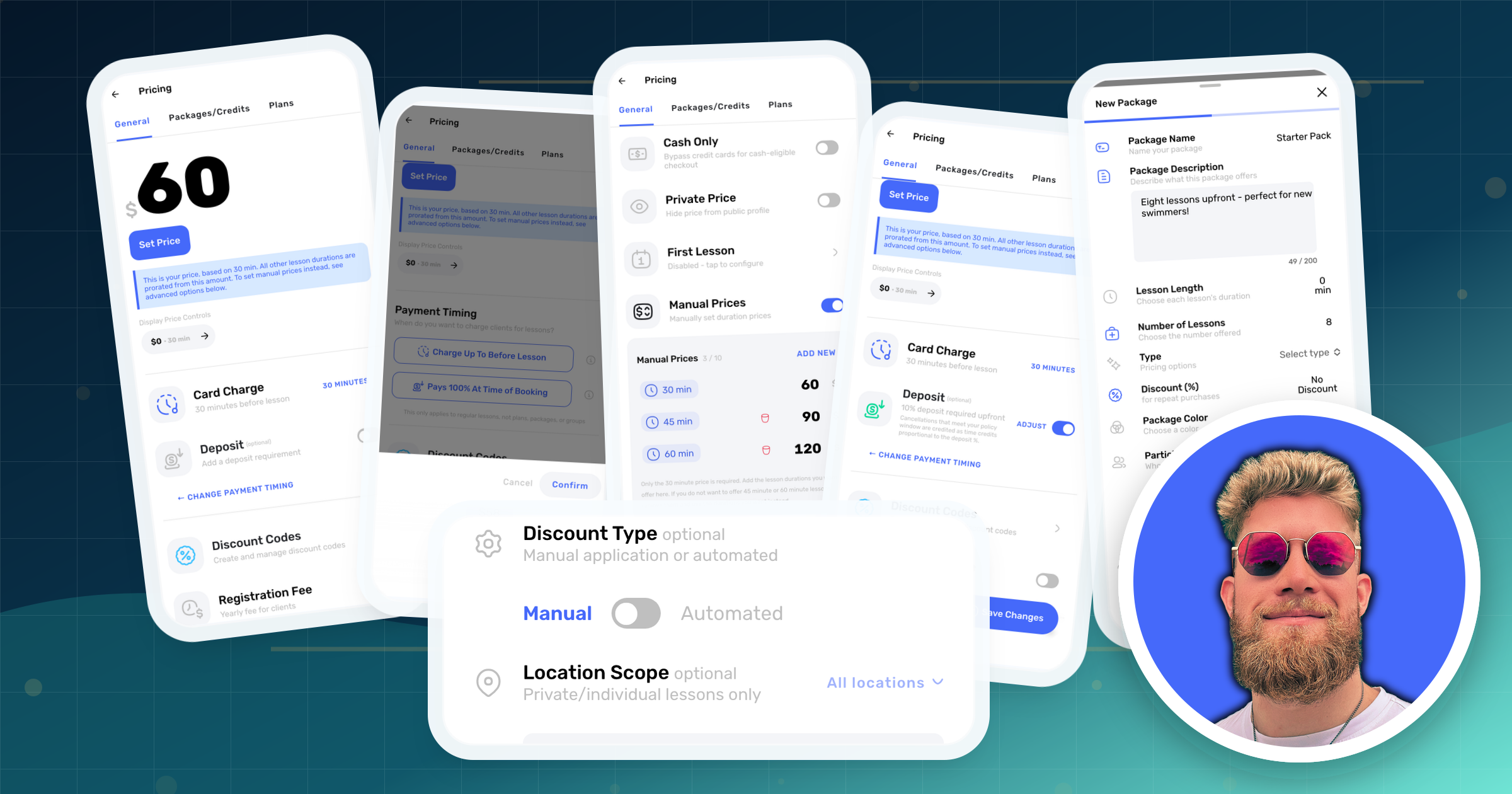
Everything above is strategy. Here's what it looks like to actually implement it - these screenshots are straight from the Swum coach app's Pricing hub.
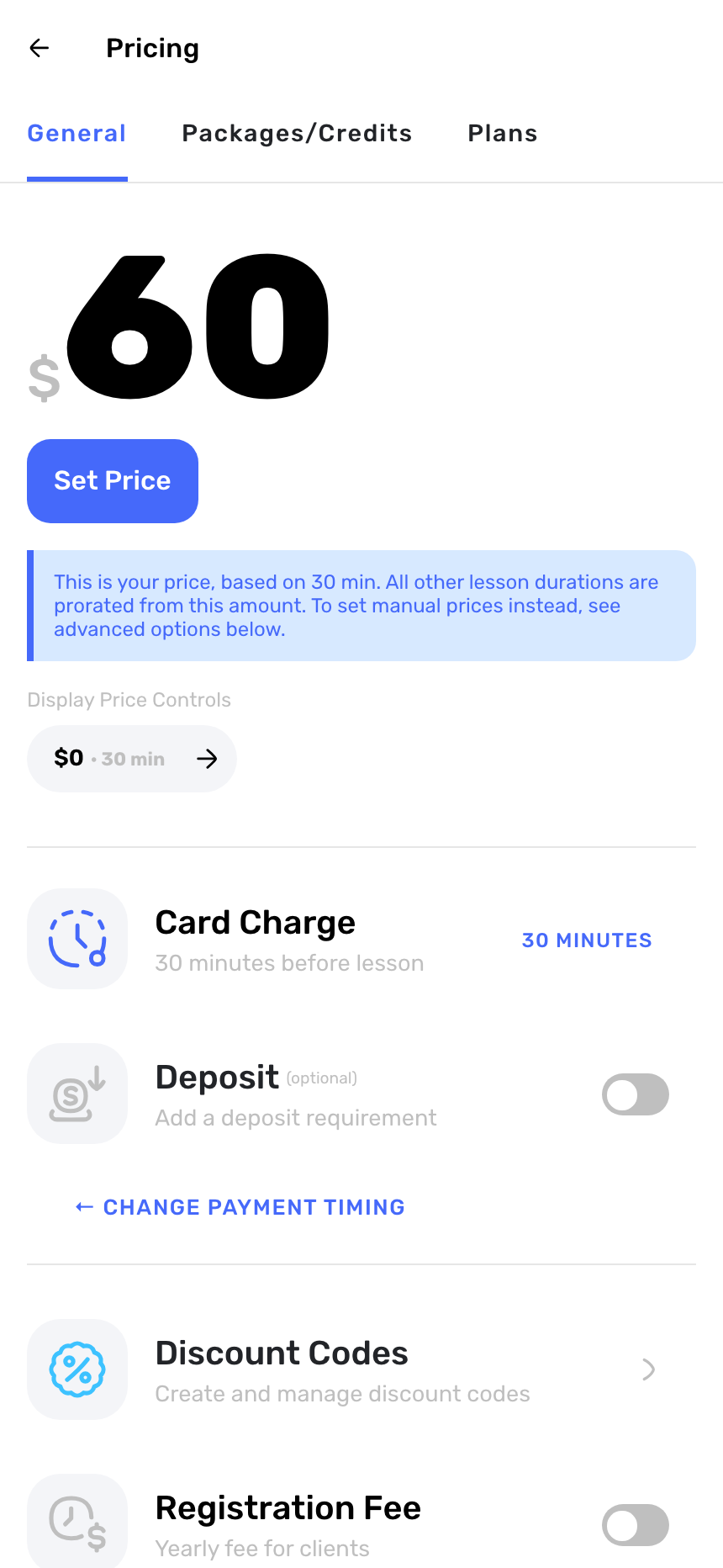
Step 1: Set your base price
Open Pricing and tap Set Price. You set one number - your 30-minute rate - and every other duration is automatically prorated from it. This is the only required pricing decision on the entire platform.
The wheel picker makes the "round numbers" advice easy to follow:
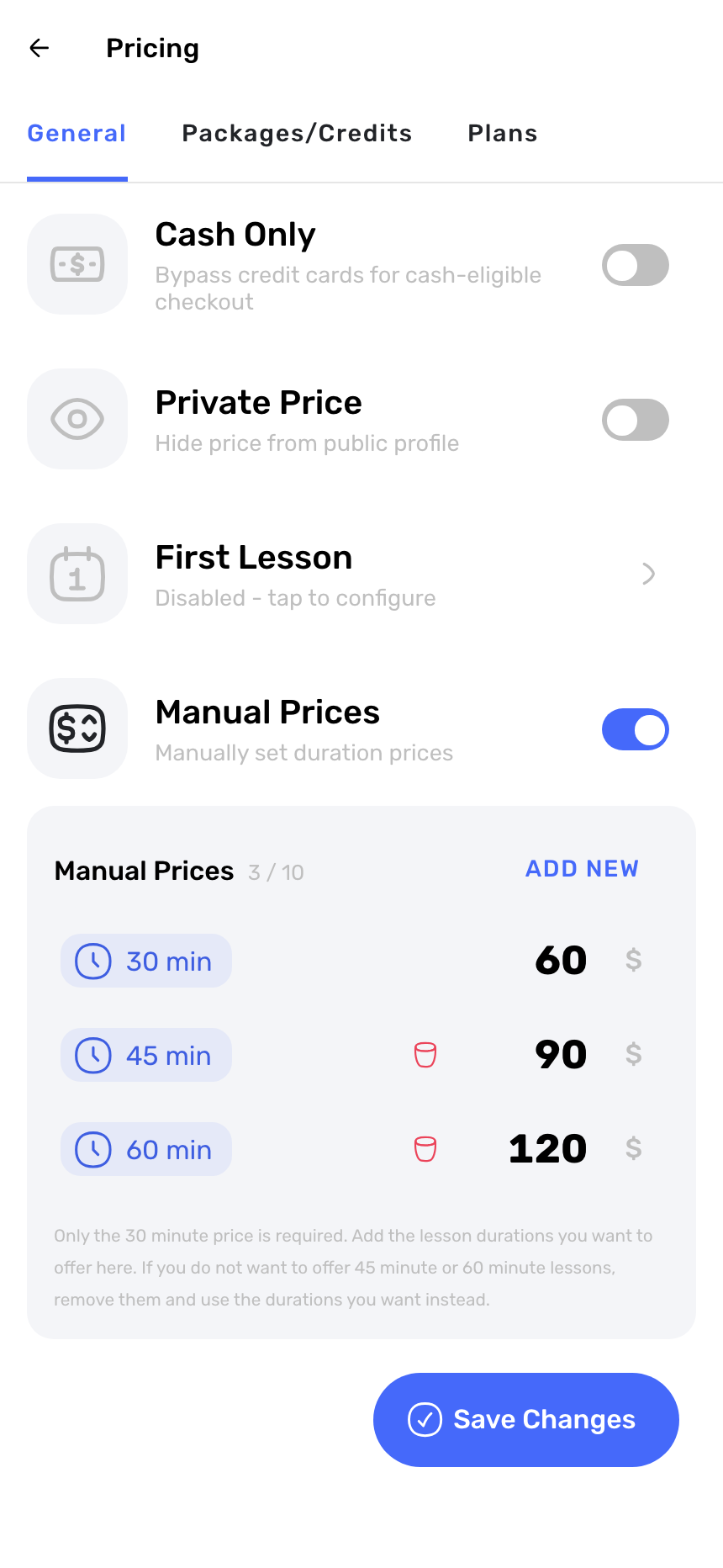
Step 2: Or hand-set each duration with Manual Prices
If prorating doesn't match your strategy (remember: most instructors charge less than 2x for 60 minutes), flip on Manual Prices under Advanced Options and set up to ten durations individually - your 30, 45, and 60-minute rates, plus any custom lengths.
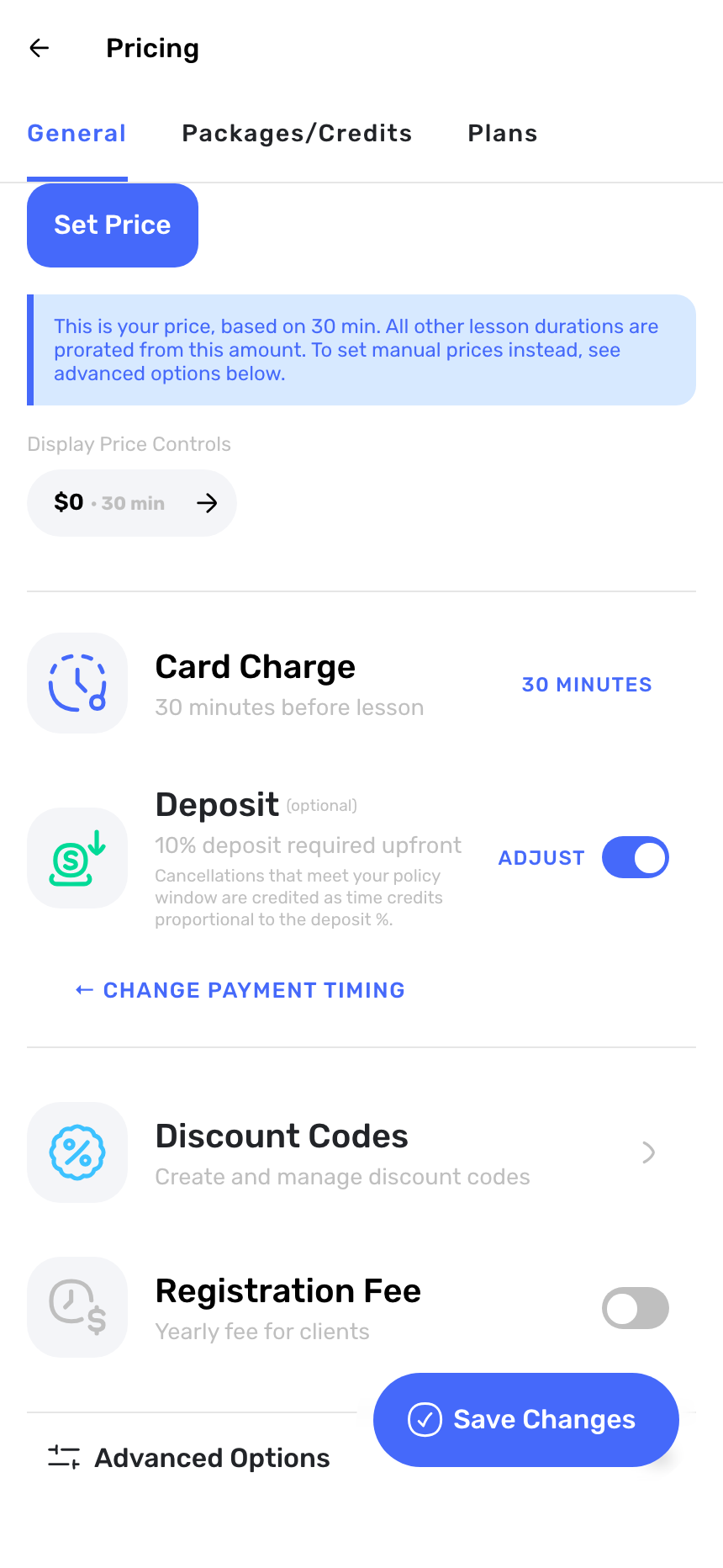
Step 3: Decide when clients pay - and require a deposit
Under Payment Timing, choose between charging up to a set window before the lesson or 100% upfront at booking. Toggle on Deposit to collect a percentage the moment a family books - cancellations inside your policy window come back to them as time credits, so it stays friendly while filtering out no-shows.
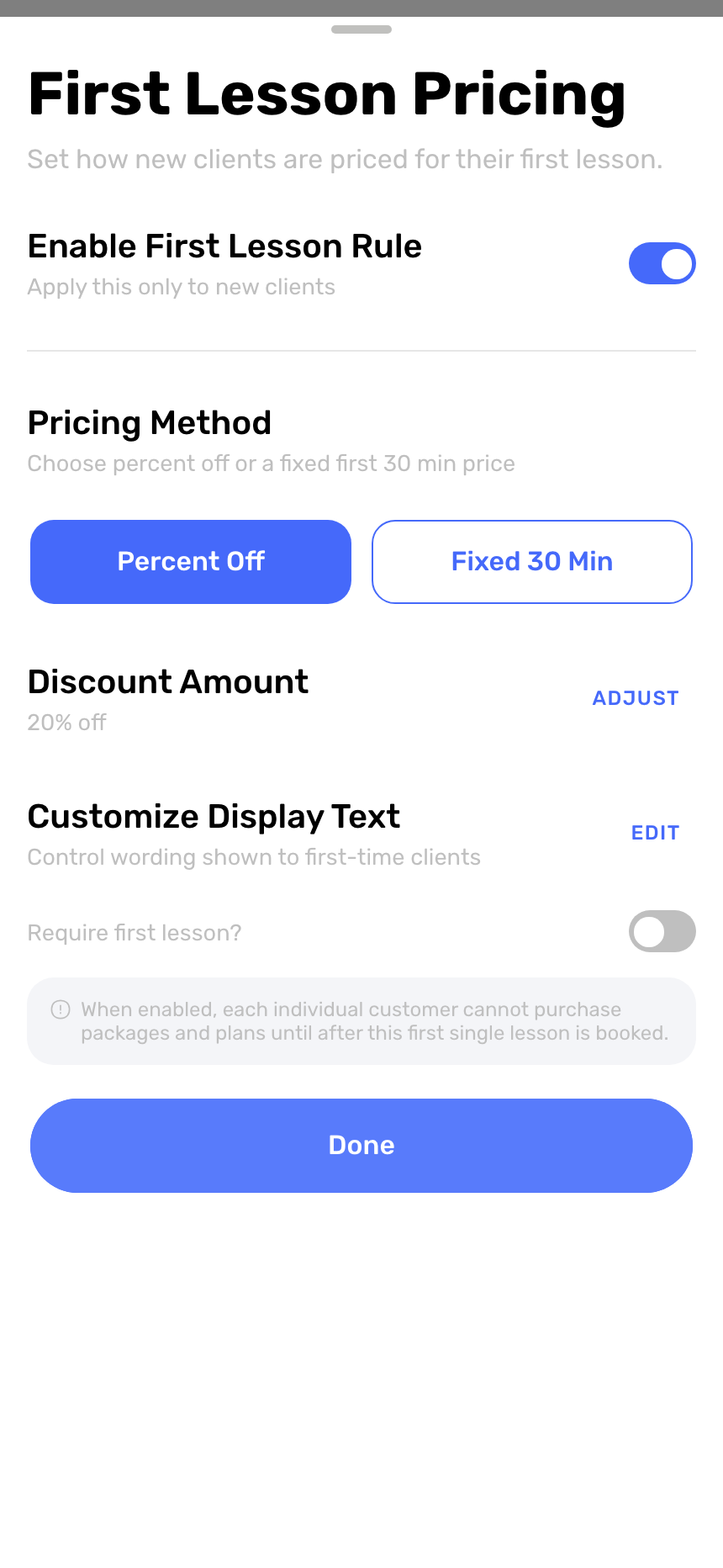
Step 4: Win new clients with First Lesson pricing
Instead of permanently discounting, give brand-new clients a one-time offer. First Lesson pricing supports a percentage off or a fixed first-30-minutes price, with custom display text shown only to first-timers.
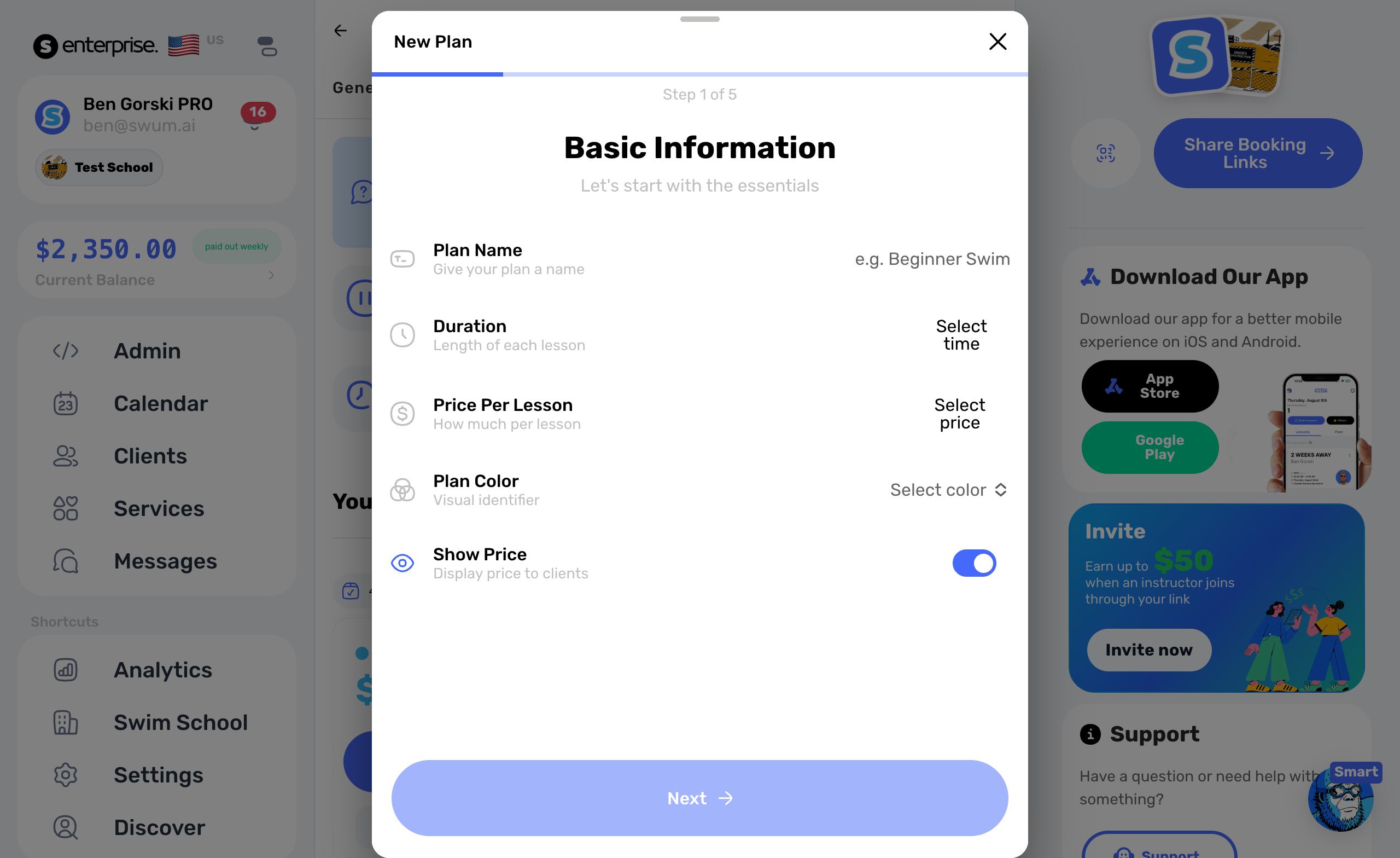
Step 5: Build your packages
In the Packages/Credits tab, create prepaid bundles - name, description, lesson length, lesson count, and your choice of pricing logic: prorated from your base rate, a percentage bulk discount, or buy-some-get-some-free. You also control credit expiration windows and which time slots credits can book.
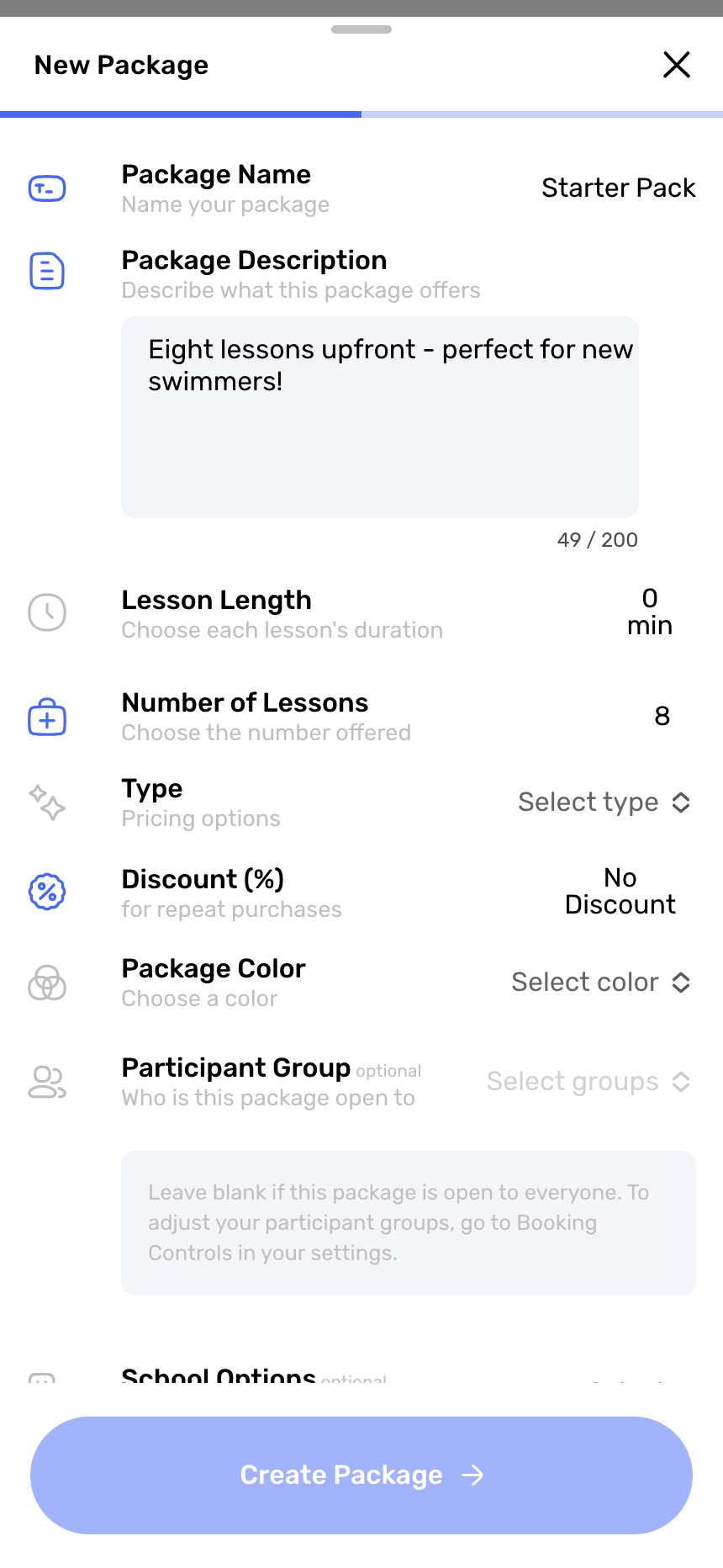
Lesson packages are also giftable and auto-credit canceled lessons back to the family - two small things that quietly boost retention.
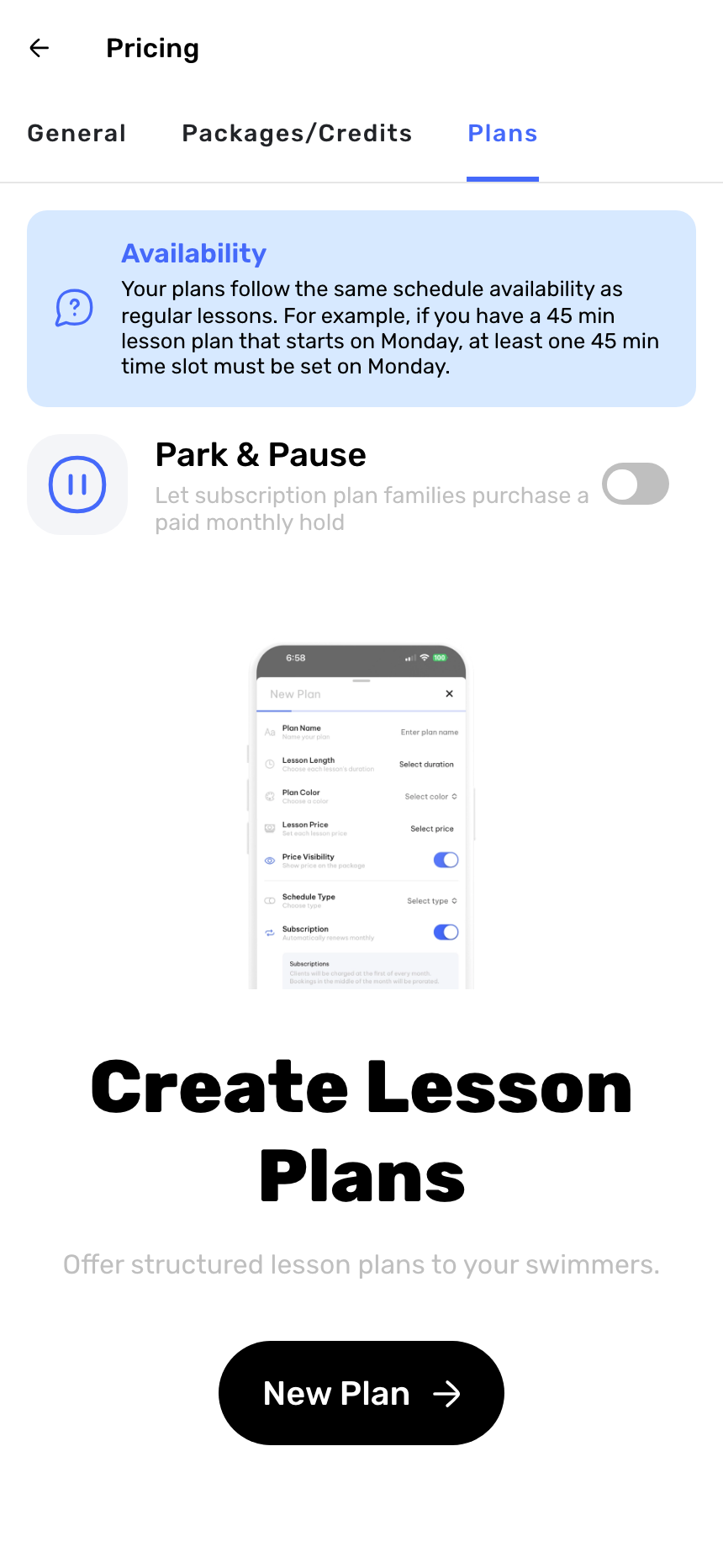
Step 6: Turn your best clients into subscribers with Plans
The Plans tab is where recurring revenue lives: subscription plans like "4 lessons a month," billed automatically, booked against your regular availability. Park & Pause lets plan families pay a small hold fee to keep their weekly spot over the summer instead of canceling - which solves the worst seasonality problem in swim instruction.
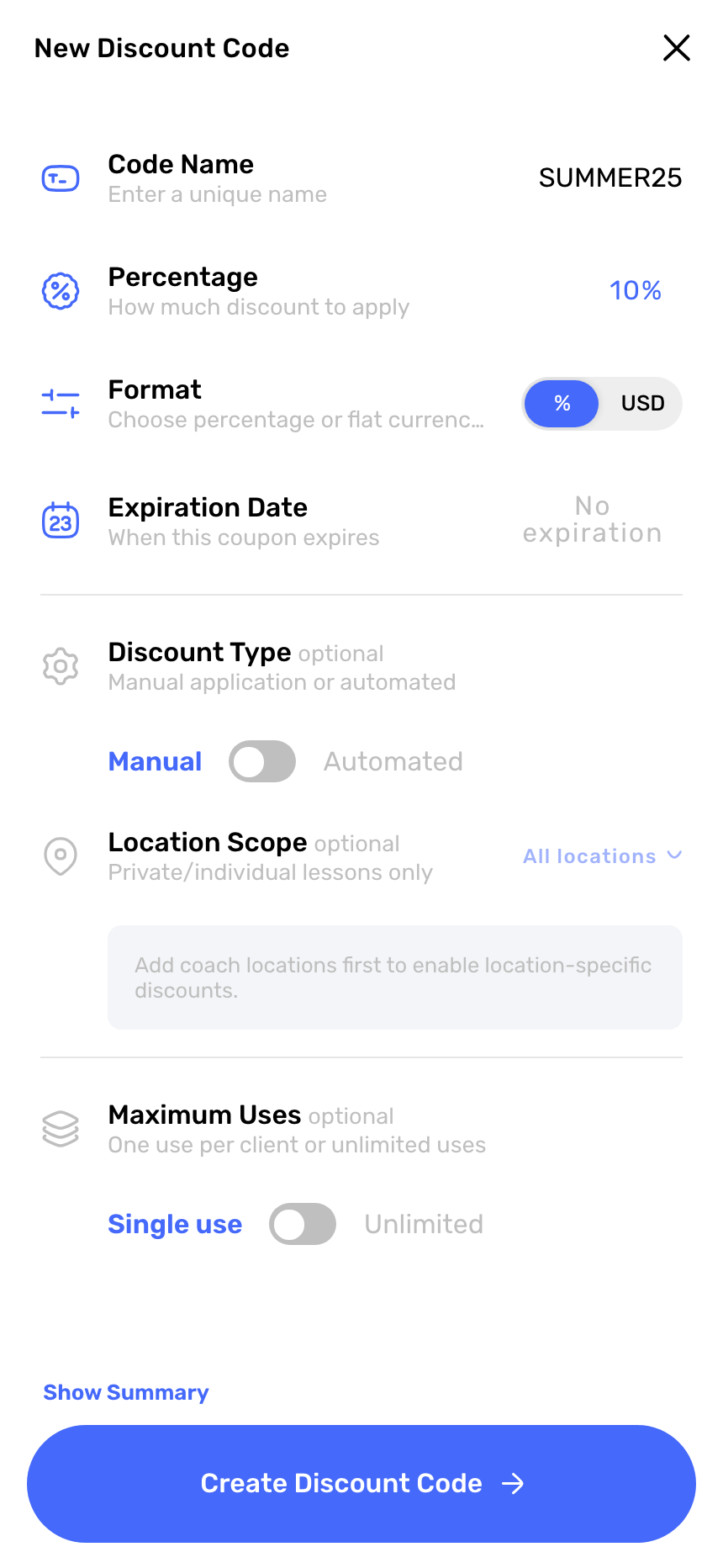
Step 7: Create discount codes for campaigns, not desperation
Discount codes let you run deliberate promotions - a SUMMER25 launch code, a sibling discount, a returning-family offer - with percentage or flat amounts, single-use or unlimited, expiration dates, and even automated triggers. Codes work across lessons, packages, plans, and group sessions.
That's the whole system: one base price, durations, payment timing, a deposit, a first-lesson offer, packages, plans, and codes. Set it once and every booking - parent self-booking included - prices itself correctly.
FAQ
How much should I charge for a 30-minute private swim lesson?
In 2026, most US instructors charge $35-$70 for a private 30-minute lesson. In major metros, experienced instructors routinely charge $80-$120. Start near the middle of your local market's range, and raise rates once you're consistently booked.
How much do swim lessons cost at the client's home?
At-home (mobile) lessons typically run 20-50% above pool-based rates, or carry an explicit travel/zone surcharge of $10-$25 per visit. The premium covers drive time and reflects the convenience value to the family.
Should swim lessons be cheaper in a package?
Yes, but modestly. The standard package discount is 8-15% versus the single-lesson rate. Parents buy packages mainly for commitment and convenience, so deeper discounts usually just give away margin.
How much more should I charge for 60-minute lessons?
Most instructors price 60-minute lessons at about 1.8-2x their 30-minute rate, and 45-minute lessons at about 1.4-1.5x. Your setup and admin time don't double with the lesson, so the per-minute rate can taper slightly.
Should I require a deposit for swim lessons?
A 10% deposit at booking is the most common setup. It dramatically reduces no-shows while staying parent-friendly - especially if cancellations inside your policy window are returned as lesson credits rather than forfeited.
When should I raise my swim lesson rates?
Review rates once a year, and raise them whenever you've been fully booked at your current rate for a season or more. Give families 30-60 days notice, raise new-client rates first, and expect minimal churn - losing zero families usually means you waited too long.
Ready to put your pricing to work? Create your free Swum account and have your rates, packages, and booking page live today - or compare what you'd take home on Standard vs. Pro.